


Discover how customizable honeycomb panels can be tailored in size, shape, edges, and finishes for architectural decoration projects. Learn how to choose the right solution for performance, appearance, and branding.
When project teams search for Aluminum Honeycomb Panels, they are usually looking for more than a standard sheet. They need a material that can fit a precise installation, match a design concept, and perform reliably in demanding environments. That is why customizable honeycomb panels have become such a strong choice for modern architectural decoration. A Custom Size Panel can reduce on-site cutting, improve installation efficiency, and help keep a project visually consistent from concept to completion. For buyers who are comparing options from an Aluminum Panel Supplier, the real value is not only in the panel itself, but also in the ability to customize the panel to the exact needs of the project. Cheonwoo’s site already positions aluminum honeycomb panels as lightweight, high-strength building materials with good flatness, easy installation, and broad use in architectural decoration and related industries.
Cut-to-Size Panels and Edge Treatments
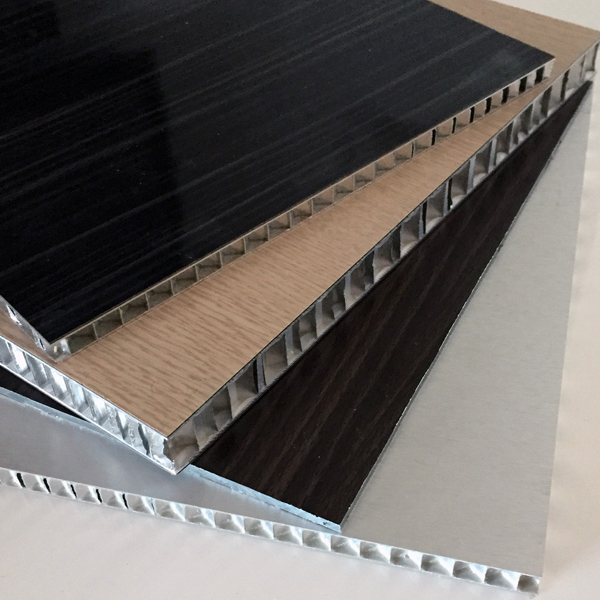
One of the biggest advantages of honeycomb panels is the flexibility to cut them to the exact dimensions required by the project. In façade cladding, interior wall systems, elevator surrounds, signage backboards, partitions, and furniture applications, the final installation size is rarely a perfect stock dimension. Cut-to-size production helps reduce waste and makes it easier to align panel joints, corner details, and finishing lines.
Edge treatment matters just as much as the panel size. Open edges can be suitable for certain concealed or framed applications, while closed edges create a cleaner appearance and better protect the panel structure during handling and installation. For many commercial projects, edge treatment is also part of the visual language of the design. A neat closed edge can make the panel look more refined, especially in areas where people see the product up close.
For projects that require a more premium appearance, edge processing should be planned together with the panel layout. When dimensions, panel orientation, and edge style are designed together, the result feels more intentional and professional.
Surface Treatments That Change the Final Look
The surface finish is often the first thing a client notices, so it plays a major role in project approval. Honeycomb panels can be customized with different surface treatments depending on the design goal, budget, and functional needs.
Anodizing is a good option when the project needs a clean metallic look with stronger surface protection. It works well for modern architectural spaces that want a refined industrial feel.
Powder coating is another popular option because it opens the door to a wide range of colors and visual effects. It is often used when the project needs a more uniform appearance or when the designer wants the panel to match other interior or exterior elements.
Digital printing gives the panel a much wider design range. Instead of being limited to solid colors or metallic textures, the surface can carry patterns, graphics, wood-like effects, or custom visuals. This is especially useful in retail, hospitality, offices, and branded commercial interiors.
Cheonwoo’s own UV printing honeycomb panel content highlights the value of graphic customization, including logos, patterns, text, and a variety of sizes, finishes, and textures. That makes printed honeycomb surfaces especially useful when the panel is part of both the decoration and the brand story.
Special Orders for Large Spans and Unique Geometries
Many architectural projects do not follow simple rectangles. Curved walls, angled ceilings, feature columns, reception walls, exhibition backgrounds, and large decorative surfaces often require special panel shapes. This is where custom production becomes a major advantage.
For large-span applications, panels may need to cover broad surfaces with fewer seams. In these cases, size planning is critical because the project must balance appearance, transportation, and structural performance. In custom work, large formats such as 2000 × 6000 mm can be considered when the project conditions allow it, especially when the goal is to create a visually continuous surface with strong design impact.
Unique geometries are equally important. Some projects require notched corners, curved edges, shaped openings, or custom cutouts for lighting, vents, and fixtures. When the supplier can produce panels based on drawings or specifications, the design team has much more freedom. Instead of adapting the design to stock sizes, the panel becomes part of the design solution itself.
This is one reason aluminum honeycomb panels are widely used in architectural decoration and other demanding applications. Cheonwoo’s site also describes use in high-rise buildings, commercial complexes, wall panels, ceilings, partitions, floors, doors, and façade cladding, which shows how adaptable the material can be across different project types.
Integrating Logos and Graphics with UV Printing
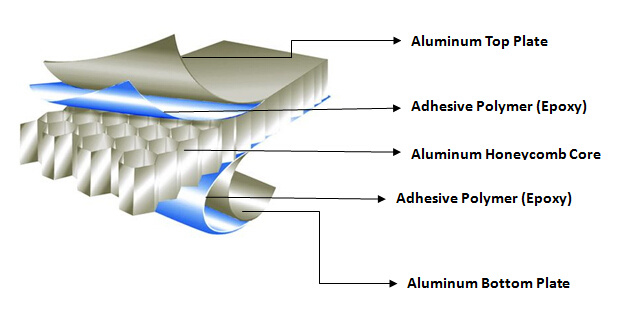
Branding is now a major part of interior and exterior design. In commercial projects, the surface is not just a surface anymore. It can become a communication tool.
UV printing technology allows logos, graphics, patterns, and text to be integrated directly into the honeycomb panel surface. This is especially valuable for corporate lobbies, retail spaces, exhibition stands, hotel interiors, and showroom walls. Instead of adding separate signage elements, the brand message can be built into the architectural surface.
This approach has several advantages. First, it creates a more unified visual identity. Second, it helps the space feel more custom and memorable. Third, it gives designers more control over the final result because the graphic and the panel material are planned as one solution.
Cheonwoo’s UV printing honeycomb panel page specifically emphasizes logo application, graphic customization, and the ability to adapt design to different spaces and purposes. That makes UV printing a strong fit for clients who want both structural performance and visual branding in one product.
Why Buyers Choose a Custom Aluminum Panel Supplier
For B2B buyers, the supplier matters as much as the product. A reliable supplier should understand not only panel manufacturing, but also project requirements, installation logic, surface aesthetics, and delivery expectations.
A strong Aluminum Panel Supplier should be able to support size customization, edge processing, finish selection, and design coordination. That reduces communication risk and helps the buyer move faster from inquiry to sampling to production. It also helps keep the project on schedule, especially when multiple panels must match exactly across a large installation.
Cheonwoo’s site presents the company as an innovative enterprise focused on honeycomb materials for architectural decoration, rail transit, and mechanical equipment, with aluminum honeycomb panels ranging from 3 mm to 150 mm. The site also highlights a “complete material solution” approach, which is exactly what many project buyers want when they need more than a standard panel off the shelf.
Final Thoughts
Customizable honeycomb panels are not just about making a panel fit. They are about making the entire project fit better: the dimensions, the surface finish, the edge detail, the graphics, and the brand message. When the panel is tailored correctly, it improves both the installation process and the final visual result.
If your project needs Aluminum Honeycomb Panels with precise dimensions, a Custom Size Panel for a special design, or a dependable Aluminum Panel Supplier for architectural decoration, custom production is the smartest path forward. With the right partner, size, shape, and finish can all work together to deliver a cleaner, more efficient, and more impressive result.
Post time: Apr-02-2026


