


Aluminum honeycomb core combines lightness with remarkable strength, making it an essential material for modern engineering. The honeycomb geometry creates a rigid structure that supports heavy loads while keeping weight low. Industries such as air conditioning, transportation, and construction rely on aluminum panels for their excellent insulation and energy-saving properties. In many buildings, aluminum honeycomb core helps maintain indoor temperatures, reducing energy consumption in both summer and winter. Vehicles and aircraft benefit from aluminum’s strength-to-weight ratio, which improves fuel efficiency and structural integrity.
Aluminum Honeycomb Core Structure and Strength
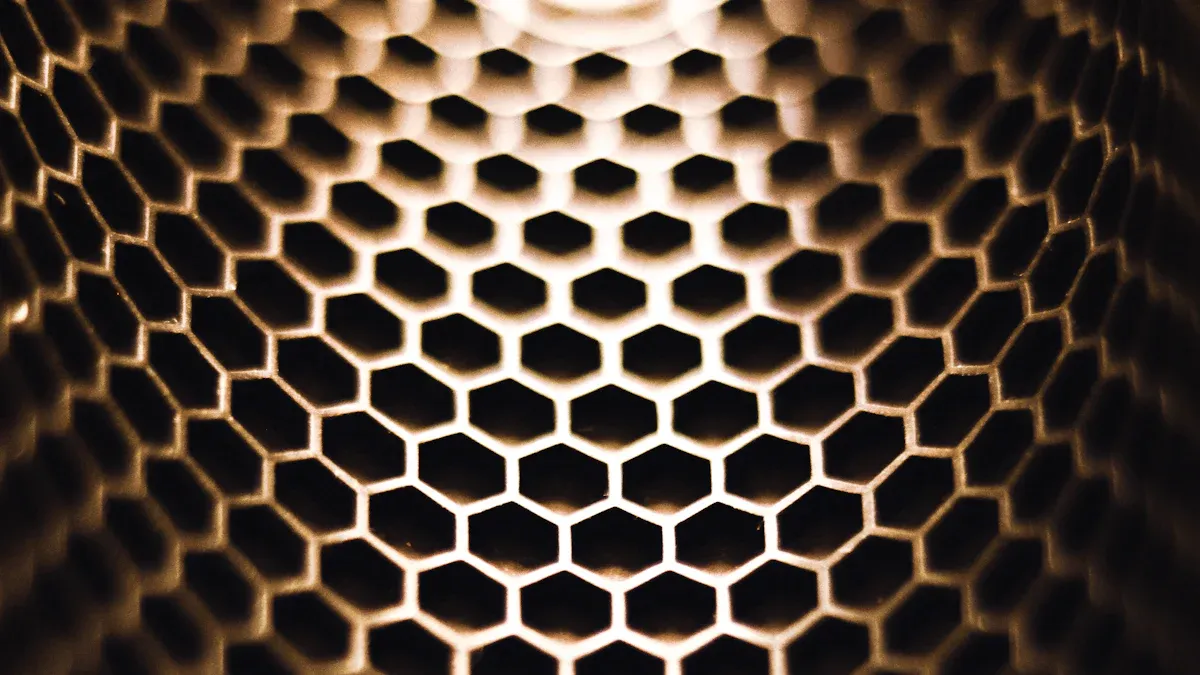
Honeycomb Geometry and Rigidity
The hexagonal aluminum honeycomb core uses a geometric design that maximizes strength while minimizing material use. The honeycomb pattern spreads stress across the entire surface, which helps maintain flatness and structural integrity. This design distributes loads evenly, reducing localized stress and preventing buckling under vertical or horizontal forces. The internal network of cells resists impact and compression, making the honeycomb core panel durable for both interior and exterior applications.
- Distributes loads evenly across the surface
- Prevents buckling under force
- Maintains flatness over large areas
- Resists impact and compression
- Provides optimal support with minimal material
The honeycomb geometry allows aluminum honeycomb panels to remain stable and rigid, even in large formats. This stability is essential for applications that require high-strength aluminum panels, such as building facades and transportation systems.
Strength-to-Weight Ratio
Aluminum honeycomb panels are known for their exceptional strength-to-weight ratio. The construction features two thin layers with a thick honeycomb core, which saves weight and reduces fabrication costs. These panels are 60% lighter than solid aluminum panels, yet they offer superior impact resistance and durability. The honeycomb structure concentrates material on the upper and lower surfaces, enhancing stiffness while keeping the panel lightweight.
An experimental study showed that aluminum honeycomb structures increase plateau stresses with higher strain rates, which means they become stronger under sudden loads. Bending tests revealed both linear elastic and nonlinear elastic-plastic behavior, demonstrating the panel’s ability to handle heavy loads without permanent deformation. Aerospace industries often use aluminum honeycomb core for its strength-to-weight advantages.
Panel Comparison: Balsa Wood vs. Aluminum
The following table compares the mechanical properties of balsa wood panels and aluminum honeycomb panels:
| Property | Balsa Wood Panels | Aluminum Honeycomb Panels |
|---|---|---|
| Density | 110 kg/m³ | Higher than balsa, varies by design |
| Compressive Strength | Good, but variable due to growth conditions | Excellent, engineered for high loads |
| Tensile Strength | Good | High |
| Flexural Stiffness | High | High |
| Shear Strength | Good | High |
| Durability | Susceptible to environmental conditions | Excellent, impact resistant |
| Weight | Very light | Heavier than balsa, but lightweight for its strength |
Aluminum honeycomb panels offer higher durability and strength compared to balsa wood. While balsa wood is very light, it is more susceptible to environmental damage. Aluminum honeycomb core panels provide reliable performance in demanding conditions, making them a preferred choice for modern engineering.
Evolution of Aluminum Honeycomb Panels
Early Materials and Innovations
Honeycomb structures have fascinated engineers for centuries. The journey began with ancient observations of natural honeycomb patterns. Over time, inventors and scientists explored ways to use these shapes in construction and manufacturing. Here is a timeline of important milestones:
- 60 BC: Diodorus Siculus describes a golden honeycomb made by Daedalus.
- 36 BC: Marcus Varro notes the efficiency of hexagonal shapes in building.
- 126: The Pantheon in Rome uses coffered structures for dome support.
- 1638: Galileo Galilei discusses hollow solids and their strength.
- 1665: Robert Hooke studies cork’s cellular structure, similar to honeycomb.
- 1859: Charles Darwin praises the honeybee comb for its perfect use of materials.
- 1890: Julius Steigel invents honeycomb production from corrugated metal.
- 1915: Hugo Junkers patents honeycomb cores for aircraft.
The honeycomb design proved to be a breakthrough in maximizing strength while minimizing weight.
Transition to Aluminum Honeycomb Core
Traditional materials like wood and paper were once used for honeycomb panels. Engineers needed stronger and lighter solutions for demanding applications. The introduction of aluminum honeycomb core changed the industry. Aluminum offered durability, corrosion resistance, and low weight. In aerospace, aluminum honeycomb panels reduced launch costs and improved payload efficiency. Automotive designers used these panels to absorb impact energy and increase safety. Construction projects benefited from lightweight panels that were easy to install and provided excellent insulation.
- Weight reduction improved energy efficiency.
- Strong mechanical properties enhanced safety.
- Aluminum honeycomb panels became the preferred choice for modern engineering.
Technological Advancements in Panels
Recent years have seen rapid progress in panel technology. Manufacturers use advanced processes to produce aluminum honeycomb panels with greater precision and lower costs. Digital transformation allows for customized designs and efficient production. Innovations in material science have led to panels that meet strict safety and environmental standards. These advancements enable the use of aluminum honeycomb panels in exterior cladding, interior walls, ceilings, furniture, and renovation projects.
- Advanced manufacturing increases efficiency.
- Digital tools support custom solutions.
- Material innovations create lightweight, strong panels for many uses.
Key Advantages of Aluminum Honeycomb Panel
Thermal and Acoustic Insulation
Aluminum honeycomb panels offer excellent heat insulation and sound absorption. The honeycomb structure traps air inside its hexagonal cells, which slows down the transfer of heat and sound. This design helps keep buildings cooler in summer and warmer in winter. The aluminum honeycomb core also improves energy efficiency by reducing the amount of energy needed for heating and cooling.
The following table shows how aluminum honeycomb panels perform in thermal insulation tests:
| Panel Size (m) | Integrity Failure Time (s) | Maximum Temperature Rise | Average Temperature Rise |
|---|---|---|---|
| 1.2 | 2285 | Increases proportionally | Relatively stable |
| 0.6 | 3005 | Increases proportionally | Relatively stable |
These results show that aluminum honeycomb panels maintain their structure and keep temperature changes stable over time.
Aluminum honeycomb panels also provide strong acoustic insulation. Many modern buildings and transportation systems use honeycomb panels to reduce noise. The internal honeycomb structure traps sound waves, lowering noise levels by 20-30dB for sound frequencies from 100 to 3200Hz. This makes aluminum honeycomb panels a popular choice for places where quiet environments are important, such as offices, schools, and trains.
Tip: Using aluminum honeycomb panels in walls and ceilings can help create a comfortable and quiet indoor space.
Fire, Moisture, and Corrosion Resistance
Safety is a top priority in construction and transportation. Aluminum honeycomb panels meet strict fire resistance standards. They have achieved Grade A2 and Grade B1 ratings in fire tests, which means they are difficult to burn or do not burn at all.
| Fire Rating | Description |
|---|---|
| Grade A2 | Mineral that doesn’t burn at all |
| Grade B1 | PE core that’s difficult to burn |
Aluminum honeycomb panels also pass important fire safety tests, such as ASTM E84 in the United States and EN 13501-1 in Europe.
Moisture and corrosion resistance are other key advantages. The aluminum alloy used in honeycomb panels provides chemical stability and protects against rust and water damage. This makes aluminum honeycomb panels suitable for humid environments and outdoor use. The durability of the aluminum honeycomb core ensures that panels last longer than many other lightweight materials.
- Aluminum honeycomb panels resist moisture and corrosion.
- The aluminum alloy composition increases durability.
- Panels remain stable and strong even in harsh conditions.
Environmental and Installation Benefits
Aluminum honeycomb panels support sustainability goals in construction and transportation. Aluminum can be recycled using only 5% of the energy needed to produce new aluminum from raw ore. Recycling aluminum saves up to 95% of energy, which helps reduce greenhouse gas emissions. For every ton of recycled aluminum, about 10 tons of CO2 emissions are avoided. Aluminum can be recycled many times without losing quality, which reduces landfill waste.
- The durability and recyclability of aluminum honeycomb panels help protect the environment.
- Circular economy practices are reducing waste, especially scrap aluminum.
- Innovations are extending product lifespan and lowering end-of-life waste.
Aluminum honeycomb panels also make installation faster and easier. Construction time can be reduced by 30%-50% compared to traditional materials like concrete. The cost of aluminum honeycomb panels is lower than steel, making them a smart choice for many projects. Their lightweight design means easier and safer installation, which saves labor costs and time.
- Aluminum honeycomb panels reduce installation time and costs.
- Panels are easy to handle and assemble.
- Long-term savings come from lower maintenance and operational costs.
Note: The design flexibility of aluminum honeycomb panels allows architects and engineers to create custom solutions for different projects.
Aluminum honeycomb panels combine strength, heat insulation, sound absorption, fire safety, and environmental benefits. Their unique honeycomb structure and aluminum honeycomb core make them a leading choice for modern construction and transportation.
Applications and Future of Aluminum Honeycomb Panels

Air Conditioning and HVAC Systems
Aluminum honeycomb panels play a vital role in air conditioning and HVAC systems. Their honeycomb structure provides excellent sound absorption and heat preservation. The panels help maintain consistent temperatures and reduce noise in buildings. The lightweight design makes installation easier and faster. The following table highlights the main features of aluminum honeycomb panels in HVAC applications:
| Application Feature | Description |
|---|---|
| Sound insulation | Limits sound wave transmission for quieter environments. |
| Heat preservation | Traps air in closed pores, improving thermal insulation. |
| Fire prevention | Meets fire retardant standards for safety. |
| Superior flatness and rigidity | Maintains strength and flatness under pressure. |
| Moisture-proof | Coated surface resists oxidation and mildew. |
| Light weight | Easier handling and installation. |
| Energy conservation | Enhances energy efficiency and environmental protection. |
| Anticorrosion | Maintains integrity in various environments. |
| Construction convenience | Quick installation with matching alloy keels. |
Aluminum honeycomb panels also prevent air leakage, which helps conserve energy. Their low thermal conductivity reduces heat transfer, making HVAC systems more efficient.
Aerospace, Rail, and Construction
Aluminum honeycomb panels are widely used in aerospace, rail, and construction. The honeycomb core keeps face sheets apart, increasing panel rigidity and strength without adding much weight. This feature is important for aircraft and metro coaches, where weight reduction improves performance and fuel efficiency. The panels provide structural integrity and sound absorption, making them ideal for rapid transit systems and building facades.
- The honeycomb structure offers a high strength-to-weight ratio.
- Aluminum honeycomb panels absorb energy and resist impact.
- These panels are used in famous projects like the London Eye and metro coaches.
Aluminum honeycomb panels help create safe, efficient, and durable structures in many industries.
Future Trends and Innovations
The market for aluminum honeycomb panels is growing quickly. Advanced digital technologies and customized solutions are shaping the future of panel design. Companies are investing in research to improve energy efficiency and precision engineering. Intelligent, automated systems are making production faster and more reliable. The market is expected to reach USD 6.783 billion by 2035, with a CAGR of 6.2% from 2025 to 2035. The Asia Pacific region will lead the market, while North America will grow rapidly.
Tip: Ongoing innovation in aluminum honeycomb panel technology will support new applications in architecture, transportation, and energy conservation.
Aluminum honeycomb panels will continue to expand into new industries, offering improved sound absorption, strength, and efficiency.
Aluminum honeycomb panels stand out as top lightweight structural solutions. Their high strength-to-weight ratio, thermal efficiency, and durability make them a favorite for engineers and architects. These panels work well in buildings, vehicles, and infrastructure. Key reasons for their popularity include:
- Lightweight design with strong support
- Excellent thermal and acoustic insulation
- Resistance to corrosion and impact
- Versatile finishes for many designs
Ongoing innovations, such as advanced manufacturing and smart technologies, will keep aluminum honeycomb panels at the forefront of modern engineering.
FAQ
What makes aluminum honeycomb core panels so lightweight?
Aluminum honeycomb core panels use a hexagonal cell structure. This design spreads material thinly but evenly, which reduces weight while keeping strength high.
How do aluminum honeycomb panels improve energy efficiency?
The honeycomb core traps air inside its cells. This slows heat transfer, which helps buildings stay cool in summer and warm in winter. Energy use drops.
Are aluminum honeycomb panels safe for use in buildings?
Yes. Aluminum honeycomb panels meet strict fire safety standards. They resist moisture and corrosion. Builders use them in schools, offices, and homes.
Can aluminum honeycomb panels be recycled?
Aluminum honeycomb panels are 100% recyclable. Recycling uses less energy than making new aluminum. This helps protect the environment.
Where are aluminum honeycomb panels commonly used?
| Application Area | Example Use |
|---|---|
| Air Conditioning | HVAC panels |
| Transportation | Metro coaches, aircraft |
| Construction | Facades, ceilings, walls |
Post time: Jan-23-2026


