


Selecting the right sustainable materials for restroom partitions is essential. Top choices include compact laminate, recycled plastic (HDPE), bamboo, recycled stainless steel, and phenolic resin. These materials have proven reliability in high-traffic environments. Compact laminate stands out for its durability and water resistance, making it ideal for toilet partitions. Recycled plastic offers strength and easy maintenance. Bamboo provides natural beauty and renewability. Recycled stainless steel and phenolic resin deliver long-term performance and safety. Choosing eco-friendly options supports environmental goals and ensures lasting value.
Why Choose Sustainable Materials?

Environmental Benefits
Sustainable Materials offer significant advantages for restroom partitions. Architects and facility managers select these options for their positive environmental impact. Many partitions made from HDPE are 100% recyclable and often contain high levels of post-consumer content. This reduces landfill waste and conserves resources. Bamboo partitions use renewable resources and require less energy to produce. The environmental benefits of different materials can be compared in the table below:
| Material Type | Key Environmental Benefits |
|---|---|
| HDPE | Recyclability, low emissions, durability |
| Phenolic | Recyclability, fire resistance, low emissions |
| Honeycomb | Use of renewable bamboo, excellent insulation, lightweight |
| Steel | Limited recyclability, higher emissions, durability offsets some concerns |
Choosing Sustainable Materials helps lower emissions and supports green building standards.
Health and Safety
Restroom partitions made from Sustainable Materials contribute to healthier indoor environments. HDPE partitions do not contain harmful urea-formaldehyde resins, which can release volatile organic compounds (VOCs). Exposure to VOCs may cause symptoms like eye, nose, and throat irritation, headaches, and dizziness. Long-term exposure can lead to serious health issues, including damage to the nervous system, kidneys, and liver. Children, seniors, and people with respiratory problems are especially vulnerable. To protect occupant health, select products that are GREENGUARD Certified and tested for low chemical emissions. Using low-emitting materials improves air quality and reduces health risks.
Long-Term Value
Sustainable Materials provide lasting value for restroom partitions. These materials resist moisture, fire, and impact, ensuring durability in high-traffic areas. HDPE and compact laminate partitions maintain their appearance and performance over time. Facility managers benefit from reduced maintenance costs and fewer replacements. Investing in Sustainable Materials supports both environmental goals and long-term savings.
Top Sustainable Materials for Restroom Partitions
Compact Laminate
Compact laminate has become a leading choice for restroom partitions in modern facilities. This material offers exceptional durability, water resistance, and fire resistance. It is engineered to withstand heavy use in high-traffic environments such as schools, airports, and commercial buildings. Compact laminate panels are easy to clean and maintain, which helps reduce long-term costs.
Chenshou Tech’s Toilet Partition Panel is a prime example of how compact laminate can deliver both performance and style. These panels feature double-sided high-pressure fireproof decorative surfaces, making them strong and impact-resistant. They resist moisture, fire, and daily wear, ensuring a long service life. Chenshou Tech provides a wide range of colors and custom sizes, allowing for seamless integration into any restroom design.
Certifications and Standards:
Compact laminate used in restroom partitions often meets rigorous environmental and safety standards. The following table highlights key certifications:
| Certification/Standard | Description |
|---|---|
| ISO9001 | Quality Management System |
| ISO14001 | Environmental Management System |
| ISO45001 | Occupational Health and Safety Management System |
| FSC Certification | Responsible wood sourcing |
| SGS | Quality and safety testing |
| Intertek | Quality assurance and safety certification |
| TUV | Technical inspection and certification services |
Compact laminate also supports green building initiatives by contributing to LEED credits and maintaining low VOC levels for improved indoor air quality.
Recycled Plastic (HDPE)
Recycled plastic, especially high-density polyethylene (HDPE), is widely used for restroom partitions due to its sustainability and resilience. HDPE partitions typically contain 20% to 100% recycled content, which helps reduce landfill waste and supports environmental goals. This material is highly durable, resistant to moisture, and easy to clean, making it ideal for humid environments.
HDPE partitions offer a lifespan of 10 to 15 years, matching the durability of other top materials like phenolic resin. Their low maintenance requirements and resistance to vandalism make them a preferred option for schools, public restrooms, and recreational facilities.
- HDPE partitions are recyclable at the end of their life cycle.
- The use of recovered plastic in partitions aligns with new U.S. regulations promoting Sustainable Materials in public restrooms.
Bamboo
Bamboo stands out as a renewable and eco-friendly material for restroom partitions. It grows rapidly and can be harvested in just a few years, unlike traditional timber that takes decades to mature. This fast growth rate helps prevent deforestation and ensures a steady supply of raw materials.
Bamboo partitions have a minimal carbon footprint. The plant absorbs significant amounts of carbon dioxide during its growth, sequestering up to five times more CO2 than conventional timber. Bamboo can regenerate from its base after harvesting, so there is no need for replanting. This cyclical harvesting method, combined with low pesticide and water requirements, results in a lower environmental impact.
Bamboo partitions offer natural beauty and strength, making them suitable for facilities seeking both aesthetics and sustainability.
Recycled Stainless Steel
Recycled stainless steel is another reliable option for restroom partitions. It contains 60% to 80% recycled material, which significantly lowers its carbon footprint compared to virgin stainless steel. The production process is energy-efficient, and the material is fully recyclable at the end of its service life.
| Aspect | Recycled Stainless Steel | Virgin Stainless Steel |
|---|---|---|
| Recycled Material Content | 60–80% | 0% |
| Carbon Footprint | Significantly Lower | Higher |
| End-of-Life Recyclability | 100% | 100% |
| Energy Efficiency in Production | Increasingly Efficient | Less Efficient |
Stainless steel partitions are known for their durability, rust resistance, and low maintenance needs. They are ideal for high-traffic and high-moisture environments, offering a long-lasting solution with minimal environmental impact.
Phenolic Resin
Phenolic resin partitions are engineered for exceptional durability and moisture resistance. The manufacturing process creates a solid, non-porous core that resists water, impact, chemicals, and wear. These partitions are completely watertight and do not absorb moisture, which prevents issues like swelling, warping, or mold growth.
Phenolic resin partitions are suitable for high-traffic restrooms in places like airports, schools, and fitness centers. They maintain their structural integrity even in damp conditions. Key factors influencing the selection of phenolic resin include its durability, moisture resistance, and customization options. Facilities benefit from cost efficiency over time due to reduced maintenance and long service life.
Other Eco-Friendly Materials
- Powder-Coated Steel: Offers affordability and decent durability but may require moderate maintenance due to potential rust in humid environments.
- Solid Plastic (HDPE): Highly durable, low maintenance, and ideal for humid settings.
- Stainless Steel: Provides excellent durability and rust resistance, with a higher initial cost but low maintenance over time.
- Solid Surface Materials (e.g., Corian®): Gaining popularity for their aesthetics, durability, and easy maintenance.
The market for restroom partitions is shifting toward Sustainable Materials, driven by green building standards and new regulations. Manufacturers are competing to offer innovative, eco-friendly solutions that meet the demands of modern facilities.
Choosing Eco-Friendly Partitions
Key Criteria
Selecting eco-friendly restroom partitions requires careful consideration of several factors. Facility managers and architects often look for materials that balance sustainability, performance, and cost. The most important criteria include:
- Durability and resistance to moisture, graffiti, and impact.
- Use of recycled or renewable materials, such as HDPE or bamboo.
- Low emissions of volatile organic compounds (VOCs) to support indoor air quality.
- Minimal maintenance requirements and long service life.
- Cost-effectiveness for both initial investment and long-term use.
Industry experts highlight that solid plastic (HDPE) partitions excel in high-traffic areas due to their durability and resistance to graffiti. Companies also prioritize products that reduce their carbon footprint and avoid the need for paint, which can emit harmful substances.
| Challenge | Solution |
|---|---|
| High cost of sustainable materials | Consider alternatives like reconstituted wood veneers, which are more cost-effective. |
| Variability in color and pattern | Use suppliers that strive for uniformity in veneer sheets to minimize variations. |
| Difficulty in matching materials for replacements | Reconstituted wood veneers provide a more consistent appearance for replacement parts. |
Durability and Maintenance
Durability and ease of maintenance are essential for restroom partitions. Materials like HDPE and phenolic resin require only occasional cleaning with mild soap and water. These surfaces do not need special sealants or polishes, which simplifies upkeep. Their non-porous nature helps prevent stains and resists damage from common cleaning agents, extending their lifespan.
Common maintenance issues and solutions include:
| Maintenance Issue | Solution |
|---|---|
| Mold | HDPE’s durability and moisture resistance prevent mold growth. |
| Aesthetic Damage | HDPE’s surface is designed to resist damage. |
| Graffiti | Anti-graffiti properties allow for easy cleaning without surface damage. |
- HDPE prevents mold growth due to its moisture resistance.
- The material is designed to resist aesthetic damage.
- Anti-graffiti properties facilitate easy cleaning.
Environmental Impact
Eco-friendly restroom partitions offer significant environmental advantages over traditional materials. Innovative prefabricated partitions, especially those made with recycled content, can reduce environmental impact by 10% to 60%. Companies increasingly focus on lowering their carbon footprint by choosing sustainable options.
The cost of sustainable partitions varies by material:
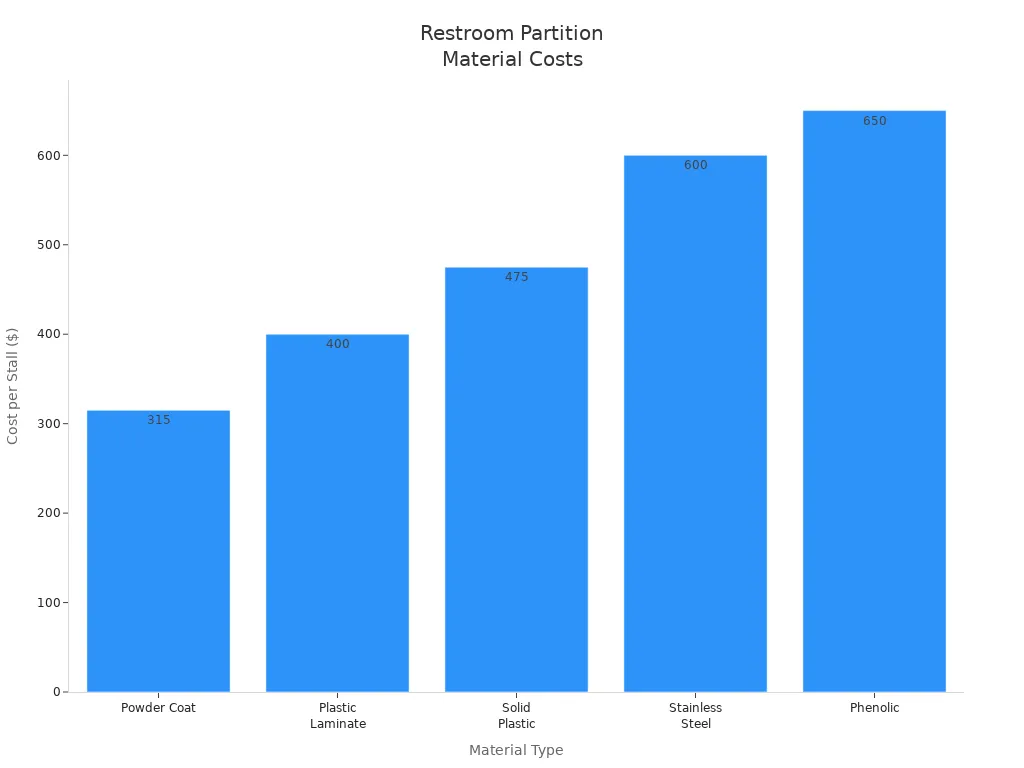
Selecting partitions that use recycled materials and emit fewer harmful substances supports both environmental goals and occupant health. These choices help facilities meet green building standards and demonstrate a commitment to sustainability.
Case Studies and Brands
Successful Installations
Facility managers and architects often look for real-world examples before choosing sustainable restroom partitions. Several projects have demonstrated the value of eco-friendly materials in demanding environments.
- Chenshou Tech Toilet Partition Panel: Many commercial buildings have installed Chenshou Tech’s compact laminate panels. These panels provide privacy, hygiene, and durability. Their water and fire resistance make them suitable for high-traffic restrooms. Clients appreciate the wide range of colors and custom sizing, which allows seamless integration into modern designs.
- DoubleTree Hotel: This hotel chain selected Hiny Hiders partitions for their restrooms. The non-porous surface improves sanitation and reduces maintenance costs. Staff reported that the partitions maintained their appearance even after frequent cleaning. Guests noted the modern look and enhanced privacy.
- The Frog and The Peach Restaurant: This restaurant chose Aria Partitions to upgrade its restroom facilities. The partitions matched the restaurant’s aesthetic and improved the overall guest experience. Positive feedback highlighted the importance of restroom quality in hospitality settings.
Tip: Facility managers can visit these locations or review project photos to see how sustainable partitions perform in real-world conditions.
Leading Brands
Many brands lead the market in sustainable restroom partitions. Each brand offers unique features that support green building goals and long-term value.
| Brand | Distinguishing Features |
|---|---|
| Chenshou Tech | Custom compact laminate panels, water/fire resistance, color variety |
| Hadrian | High recycled content, supports LEED certification |
| Santana Products | Durable, customizable designs for various applications |
| IKEA | Eco-friendly wooden options for modern interiors |
Facility managers can trust these brands to deliver reliable, sustainable solutions for restroom projects.
Choosing sustainable restroom partitions delivers lasting value for facilities and users. Top materials like compact laminate, HDPE, and solid plastic offer:
- Longevity with warranties up to 25 years
- Low maintenance and easy cleaning
- Resistance to moisture, scratches, and vandalism
- Cost-effectiveness and reduced environmental impact
- Versatility in design and color options
Eco-friendly partitions improve hygiene and satisfaction. Real-world projects show reduced water use and enhanced brand reputation. Facility managers should use these criteria and examples to select reliable, sustainable solutions.
FAQ
What makes compact laminate a sustainable choice for restroom partitions?
Compact laminate uses high-pressure decorative layers and often includes recycled content. It resists water, fire, and impact. This durability reduces replacement frequency, which lowers environmental impact.
How does HDPE compare to other materials in terms of maintenance?
HDPE requires minimal maintenance. Facility staff can clean it with mild soap and water. It resists stains, graffiti, and moisture, making it ideal for busy restrooms.
Are bamboo partitions strong enough for commercial restrooms?
Yes. Bamboo partitions offer impressive strength and stability. Their rapid renewability and natural resistance to moisture make them suitable for high-traffic commercial spaces.
Which certifications should I look for in sustainable restroom partitions?
Look for certifications such as ISO14001, FSC, GREENGUARD, and LEED compliance. These indicate responsible sourcing, low emissions, and environmental stewardship.
Can sustainable partitions be customized for unique restroom layouts?
Absolutely! Many brands, including Chenshou Tech, offer custom sizes, colors, and accessories. This flexibility ensures a perfect fit for any restroom design.
Post time: Mar-14-2026


