


When specifying an aluminum honeycomb core for sandwich panel manufacturing, selecting between 3003 vs 5052 aluminum honeycomb represents one of the most critical engineering and budgeting decisions. While both alloys share virtually identical volumetric densities, their underlying metallurgy creates significant divergence in mechanical yield limits, node shear strength, and long-term corrosion resistance. Choosing the wrong grade either leads to premature structural failure in harsh environments or inflates procurement costs by 15% to 25% on standard architectural projects.
Key Takeaways: 3003 vs. 5052 Selection
Metallurgical Base: AA3003 is an aluminum-manganese alloy optimized for commercial ductility and cost efficiency, whereas AA5052 is an aluminum-magnesium alloy engineered for high strength and extreme marine corrosion resistance.
Mechanical Strength: 5052 honeycomb cores deliver roughly 30% to 35% higher compressive and shear strength than 3003 cores at equivalent cell size and foil gauge thickness.
Salt Spray Durability: AA5052 passes 1,000+ hours of ASTM B117 salt spray testing with zero pitting, making it mandatory for marine grade honeycomb core solutions and offshore platforms.
Economic Best Practice: Specify AA3003 for building facades, interior ceilings, and toilet partitions; reserve AA5052 for rail transit floors, naval bulkheads, aerospace, and high-load CNC vacuum tables.
Metallurgical Composition: Al-Mn vs. Al-Mg Alloys
The performance gap between 3003 and 5052 honeycomb cores originates at the atomic level in their respective alloy compositions defined under EN 573-3 and ASTM B209 standards:
- AA3003 (Al-Mn 3000 Series): Contains 1.0% to 1.5% Manganese (Mn). Manganese increases strength over commercially pure aluminum (1100 series) while maintaining superior foil elongation and high ductility. This makes 3003 foil easier to slice, stack, and expand into uniform hexagonal cells without micro-tearing along the adhesive nodes.
- AA5052 (Al-Mg 5000 Series): Contains 2.2% to 2.8% Magnesium (Mg) along with 0.15% to 0.35% Chromium (Cr). Magnesium provides solid-solution hardening that significantly boosts yield strength and fatigue limits, while chromium provides exceptional resistance to chloride stress corrosion cracking.
Mechanical Properties: Head-to-Head Comparison
To evaluate how alloy chemistry translates into physical load-bearing performance, the table below compares bare foil and expanded honeycomb core metrics under standard ASTM C365 (Flatwise Compressive Strength) and ASTM C273 (Core Shear Strength) test protocols:

Corrosion Resistance in Marine & Industrial Atmospheres
Corrosion in sandwich structures is insidious because it occurs inside the closed cells where moisture, condensation, or saline atmospheres can become trapped. Under ASTM B117 accelerated salt spray exposure:
Corrosion Mechanism Breakdown: In high-chloride environments (coastal zones, marine hulls, splash zones), AA3003 foil requires a specialized chemical conversion coating or epoxy primer to prevent intergranular micro-corrosion. In contrast, AA5052 forms a self-healing, tightly adhering magnesium oxide passivation film that prevents chloride ion penetration up to 1,000+ continuous test hours.
Cost Analysis & Application Decision Matrix
Because 5052 raw aluminum ingots carry higher market premiums and require more precise rolling controls than 3003, using 5052 where it is not structurally required creates unnecessary project expenditure. Use this decision matrix to align grade selection with project requirements:
Engineering Specification Checklist: Verifying Alloy Grade on Mill Test Certificates (MTC)
Verify Chemical Composition: Confirm Magnesium (Mg) is 2.2% to 2.8% on MTCs for 5052 orders; confirm Manganese (Mn) is 1.0% to 1.5% for 3003 orders.
Node Line Adhesive Certification: Ensure the adhesive system meets high-temperature curing ratings (≥ 180°C) without node slippage.
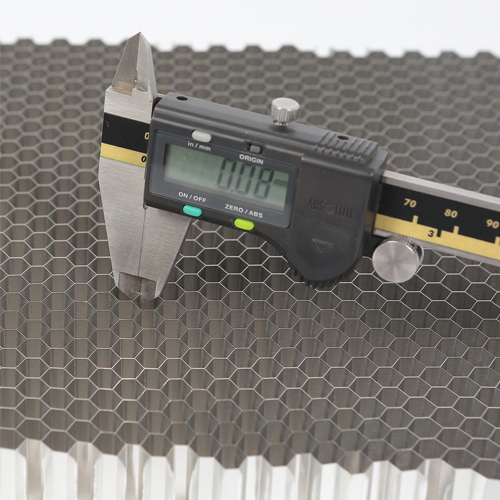
Foil Thickness Gauge Check: Use micrometer measurements to confirm foil gauge tolerance is held within ±0.003 mm across master rolls.
Frequently Asked Questions (FAQ)
Is 5052 aluminum honeycomb heavier than 3003 aluminum honeycomb?
No. In fact, 5052 alloy has a slightly lower raw density (2.68 g/cm³) than 3003 alloy (2.73 g/cm³), making a 5052 honeycomb core approximately 1.8% lighter at the exact same foil thickness and cell size.
Can AA3003 honeycomb core be used in exterior architectural curtain walls?
Yes. AA3003-H18 is the worldwide industry standard for architectural facade panels. Because the core is sealed between protective face sheets and sealed with silicone perimeter gaskets, 3003 provides optimal rigidity and wind-load resistance without the higher cost of 5052.
Why is 5052 honeycomb mandatory for marine and shipbuilding projects?
Marine applications subject sandwich panels to continuous salt spray, high humidity, and severe cyclic hull wave impact. The magnesium content in AA5052 provides essential resistance to salt-induced intergranular corrosion and delivers the dynamic shear fatigue limits required by international marine classification societies.
Post time: Oct-23-2026


