


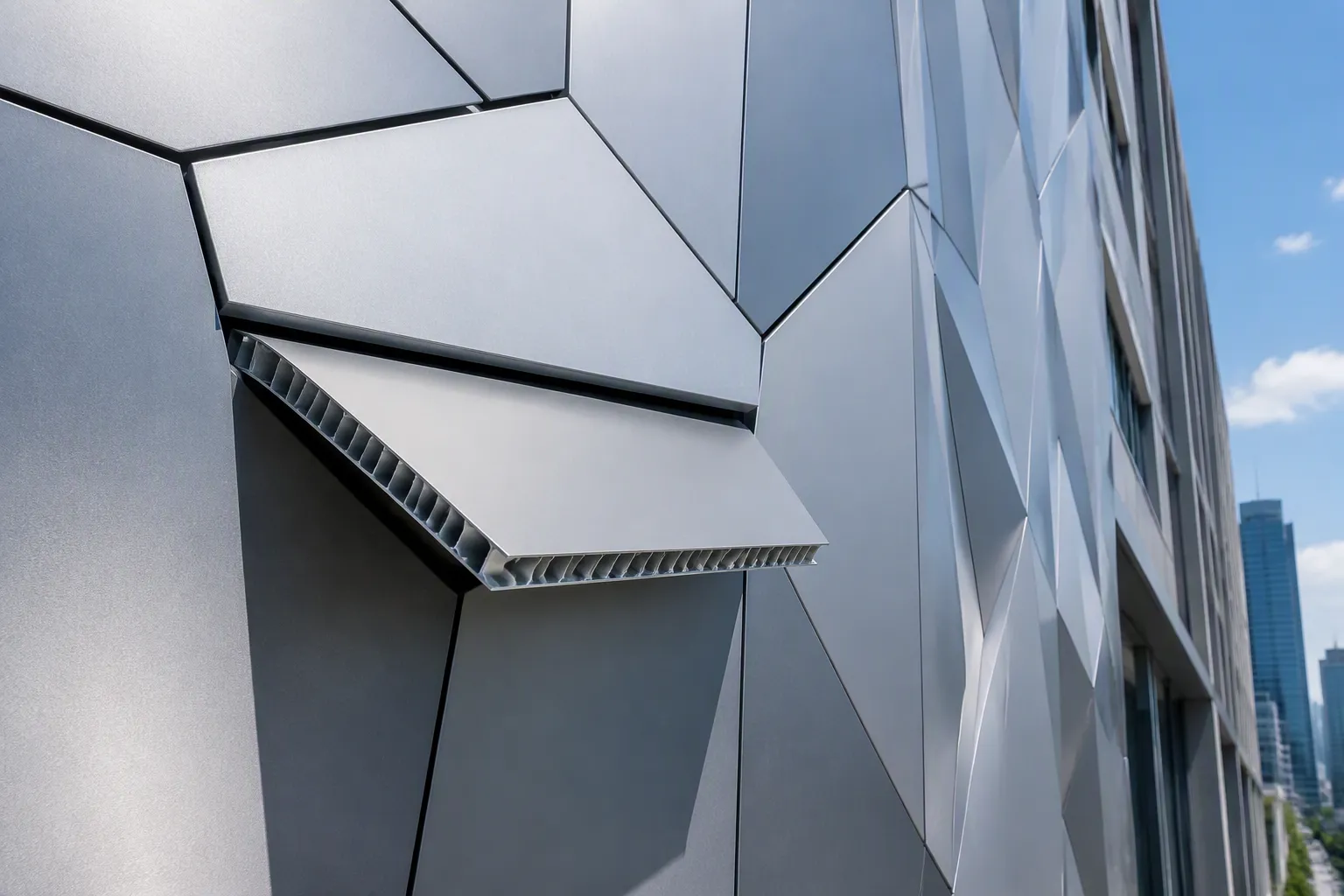
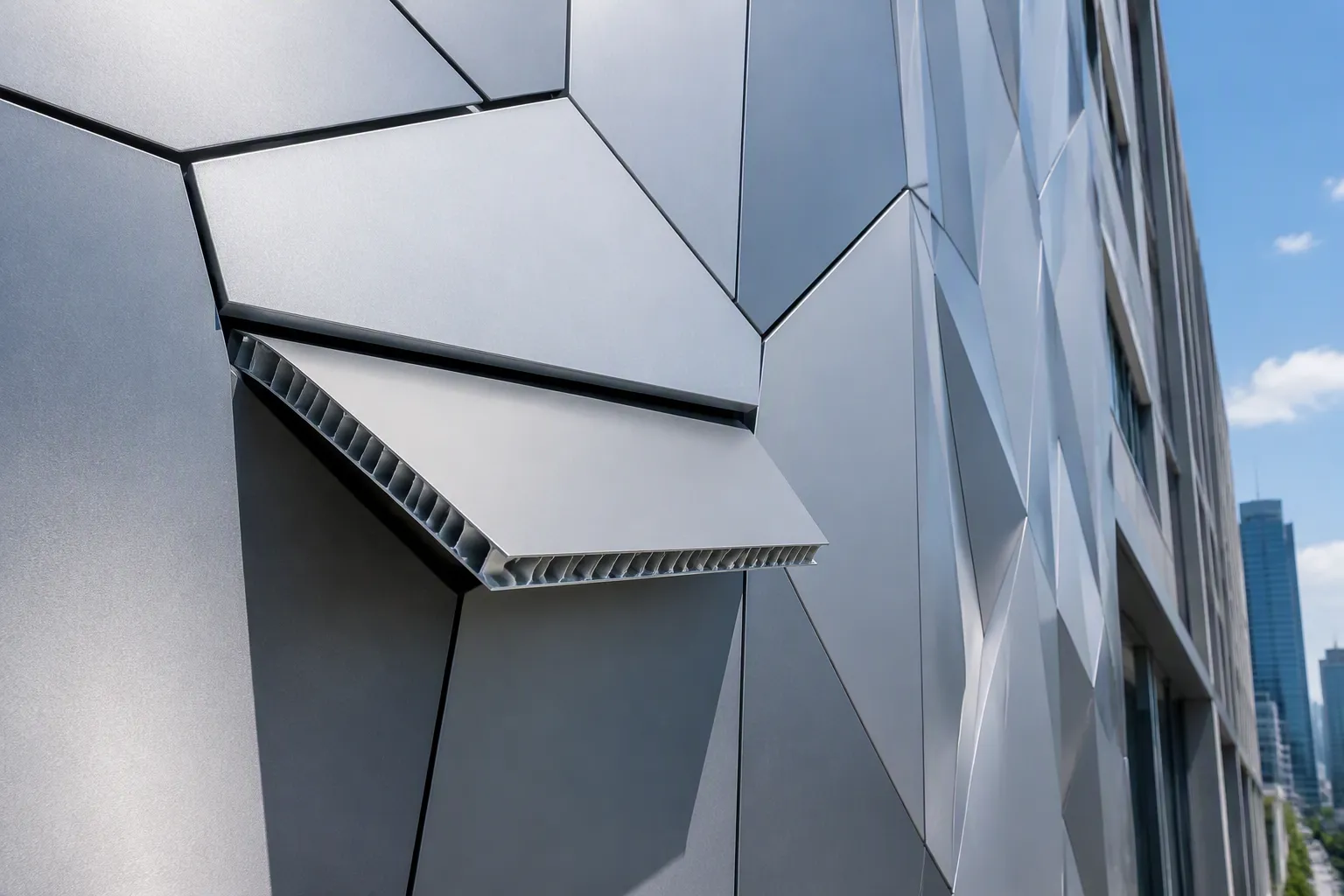
Architects and contractors often struggle with traditional facade materials. Heavy panels demand massive structural support, driving up costs. Large flat surfaces also risk “oil-canning”—visible waviness that ruins a clean aesthetic. The aluminum honeycomb panel used for building decorations solves these problems. Its aerospace-inspired honeycomb core delivers unmatched rigidity with minimal weight. This material offers exceptional strength for building envelopes while maintaining perfect flatness.
This article examines the distinct benefits of aluminum honeycomb panels for building decorations. We will explore key applications in modern architecture, from exterior curtain walls to interior ceiling systems. A practical selection guide follows, helping you choose the right core density and coating. By the end, you will specify panels that ensure long-term durability, aesthetic flatness, and cost-effective installation. Avoid common pitfalls—understand how this aviation-derived material transforms facades for commercial complexes and beyond.
Key Takeaways
- Aluminum honeycomb panels offer high strength and rigidity with low weight, reducing building load and installation costs.
- Their superior flatness prevents oil-canning, ensuring a pristine appearance on large facades.
- These panels resist wind loads and impacts, making them ideal for high-rise and storm-prone areas.
- They provide thermal insulation and fire retardancy, improving energy efficiency and safety.
- Choose PVDF coatings and proper core thickness for long-term durability and performance.
Why Choose Aluminum Honeycomb Panels for Facades?
Unmatched Strength-to-Weight Ratio
The engineering advantage of aluminum honeycomb panels begins with their core structure. Hexagonal cells, inspired by aviation design, create a material that delivers high strength and good rigidity without the burden of excess mass. This lightweight and low density characteristic reduces the load on a building’s primary structural frame. Contractors can handle larger sections with less equipment, which shortens installation timelines and lowers labor expenses.
Compare this composite with solid aluminum or steel cladding. Those heavier options demand reinforced substructures and more robust anchoring systems. Over time, their own weight can induce sagging or creep, especially on tall elevations. Aluminum honeycomb panels avoid this problem entirely. The core transfers stress evenly across the panel face, so the material maintains its shape under sustained load. Architects specify this product when they need both lightweight convenience and dependable structural performance.
Superior Flatness and Structural Rigidity
Large flat surfaces often reveal a common defect: oil-canning. This visible waviness appears when a panel’s face sheet lacks sufficient stiffness. Solid aluminum cladding is prone to this issue because its moderate rigidity cannot resist localized buckling. Aluminum honeycomb panels, however, offer exceptional rigidity. The honeycomb core provides a high moment-of-inertia, which is the key structural property that reduces oil-canning. This allows for oversized panels without the surface deflection seen in solid aluminum.
| Panel Type | Structural Rigidity | Oil-Canning Susceptibility |
|---|---|---|
| Solid Aluminum Cladding | Moderate | Prone to oil-canning |
| Aluminum Honeycomb Panel | Exceptional | Zero deflection (prevents oil-canning) |
The result is a super flat surface that remains true even across wide spans. Manufacturers control this quality tightly during production.
These tolerances matter for facades where sunlight rakes across the elevation. Any distortion becomes immediately visible. The rigidity of this aluminum honeycomb panel also resists wind-driven flexing, preserving the crisp lines that modern architecture demands. For designers who refuse to compromise on visual perfection, this structural stability proves indispensable.
Core Benefits for Building Envelopes
High Wind Load Resistance and Impact Strength
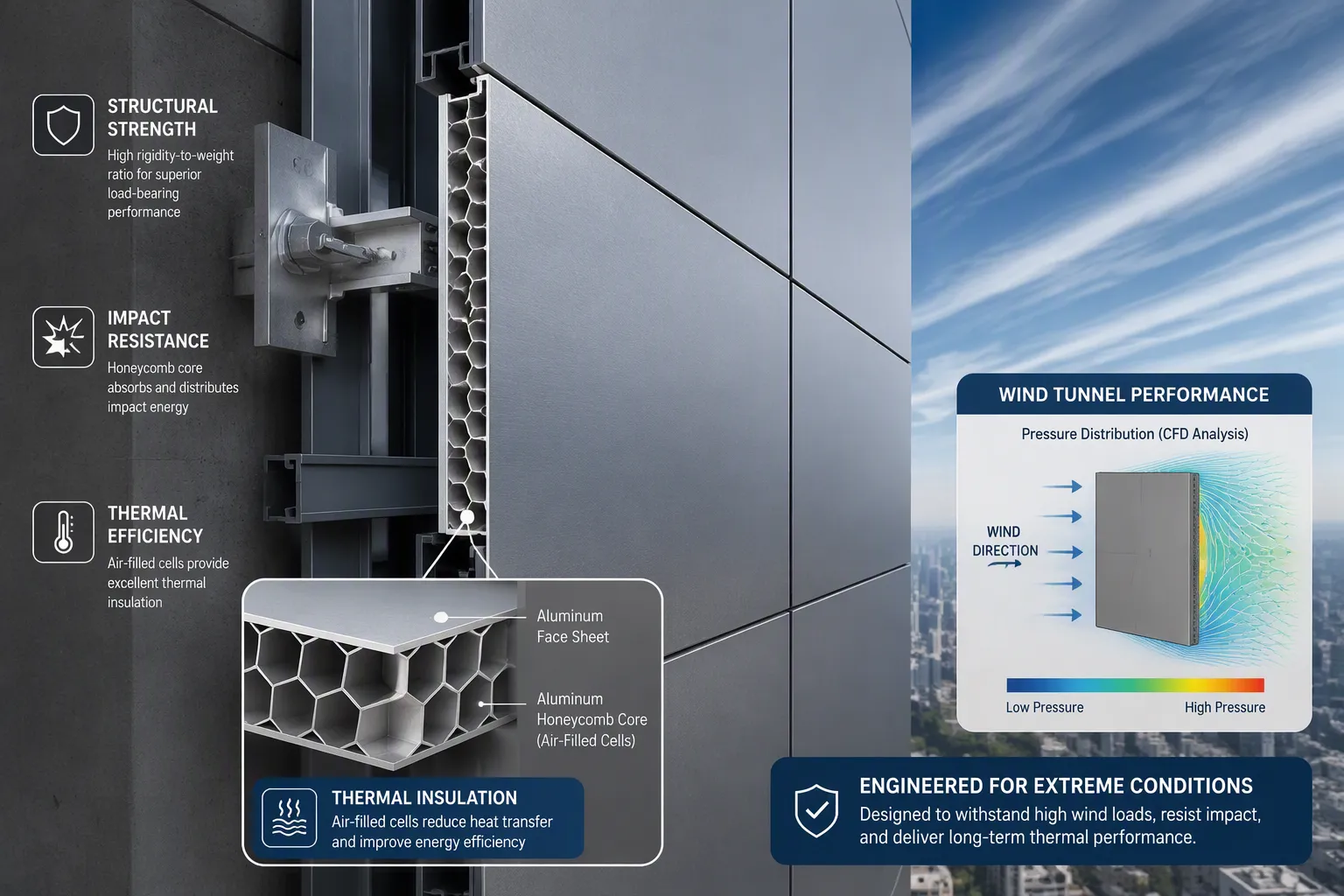
High-rise facades face relentless forces. Wind pressure increases with elevation, creating suction and positive loads that stress every cladding component. The flat, rigid surface of aluminum honeycomb panels handles these demands without visible deflection. This stiffness proves essential for tall structures where even minor flexing can compromise the building envelope’s integrity. Engineers trust this material for its predictable response under extreme weather events.
The honeycomb core distributes localized forces across a wide area. This structural behavior prevents denting from hail, debris, or accidental impact during maintenance. Solid aluminum sheets of comparable thickness would deform permanently under the same conditions. The composite construction absorbs energy more effectively, protecting the facade’s appearance and function. For coastal regions prone to storms, this impact resistance adds a critical layer of protection.
Wind tunnel testing on high-rise projects consistently demonstrates the advantage of rigid panels. The aluminum honeycomb panel used for building decorations maintains its geometry even when surrounding materials show stress. This stability reduces long-term maintenance costs. Building owners avoid frequent replacements or repairs. The material’s performance under cyclic loading—repeated wind gusts over decades—remains reliable, a key consideration for curtain walls on exposed sites.
Thermal Efficiency and Fire Retardancy
Modern building codes demand responsible energy consumption. Aluminum honeycomb panels contribute meaningful thermal performance to the building envelope. The air-filled cells within the core create a barrier that slows heat transfer. This sound insulation and heat insulation property reduces heating and cooling loads. Occupants enjoy more stable indoor temperatures. Energy bills decrease accordingly.
The aluminum faces reflect radiant heat effectively. This characteristic helps moderate temperature swings between day and night. In summer, less solar heat penetrates the interior. In winter, interior warmth escapes more slowly. The combination of reflective surfaces and the insulating core creates a comfortable environment without excessive mechanical system reliance.
Fire safety remains paramount in commercial construction. Aluminum honeycomb panels offer excellent fire performance. The material is non-combustible, meaning it will not contribute fuel to a fire. This quality helps architects meet stringent fire safety regulations. The aluminum skins and core do not emit toxic smoke when exposed to flames. This safety profile protects occupants during evacuation and assists firefighters in their work.
The non-combustible and moisture resistance characteristics extend the material’s service life. Humidity and condensation do not degrade the core structure. Unlike organic core materials, aluminum will not rot, warp, or support mold growth. This durability preserves both safety and appearance over decades of service. The material’s inherent stability also supports its acoustic performance. The dense aluminum faces and cellular core absorb sound energy, reducing noise transmission between floors or from exterior sources. This sound insulation and heat insulation combination makes aluminum honeycomb panels a comprehensive solution for building envelopes.
Key Applications in Architecture and Building Decorations
Exterior Curtain Walls and Spandrel Panels
The aluminum honeycomb panel used for building decorations excels in exterior curtain walls. Architects specify this material when they demand pristine flatness across expansive elevations. Spandrel panels—the opaque sections between vision glass—require exceptional dimensional stability. Aluminum honeycomb panels deliver precisely this performance. Their rigidity prevents oil-canning and distortion, maintaining pristine surfaces throughout the building’s service life.
| Performance Requirement | Supporting Evidence |
|---|---|
| Flatness & Rigidity | Prevents oil-canning and distortion |
| Dimensional Stability | Maintains pristine flat surfaces over time |
| Weather Resistance | Protects against moisture infiltration in rainscreen systems |
| Structural Integrity | Suitable for demanding exterior cladding |
| Fire Resistance | Achieves Class A fire ratings; aluminum is non-combustible |
| Durability | Withstands extreme temperatures, UV radiation, corrosive pollutants |
Interior Column Covers and Ceiling Systems
Interior applications demand equally rigorous performance. Aluminum honeycomb panels serve as the gold standard for high-rise column covers. Their flat, modern aesthetic enhances elevator lobbies and escalator cladding without overloading structural elements. The material offers excellent impact resistance and energy absorption. Moisture resistance prevents degradation in humid environments. Long-span capability eliminates sagging concerns.
Large ceiling systems in transit hubs and shopping complexes benefit substantially from this material. The honeycomb core distributes mechanical loads efficiently, reducing localized stress while maintaining minimal weight. This structural logic proves particularly valuable for expansive open spaces.
- Lightweight with High Strength: Eases installation and reduces structural load
- Superior Flatness: Maintains excellent surface quality even at large sizes
- Good Acoustic Performance: Perforated designs improve sound absorption
- Fire and Corrosion Resistance: Reliable performance for high-traffic environments
- Flexible Design Possibilities: Supports various finishes, sizes, and shapes
The aluminum honeycomb panel delivers a beautiful appearance and easy to clean surface. This quality matters in public spaces where visual appeal and hygiene intersect. For architectural applications spanning both exterior and interior realms, the material demonstrates remarkable versatility. Its recyclable nature supports sustainable building practices. Designers appreciate the freedom to create bold geometric forms without compromising structural integrity. The panels’ modularity allows efficient installation and replacement—critical for transit hubs requiring minimal operational downtime. These building applications showcase how advanced composite engineering transforms modern architectural expression.
The Essential Selection Guide for Aluminum Honeycomb Panels
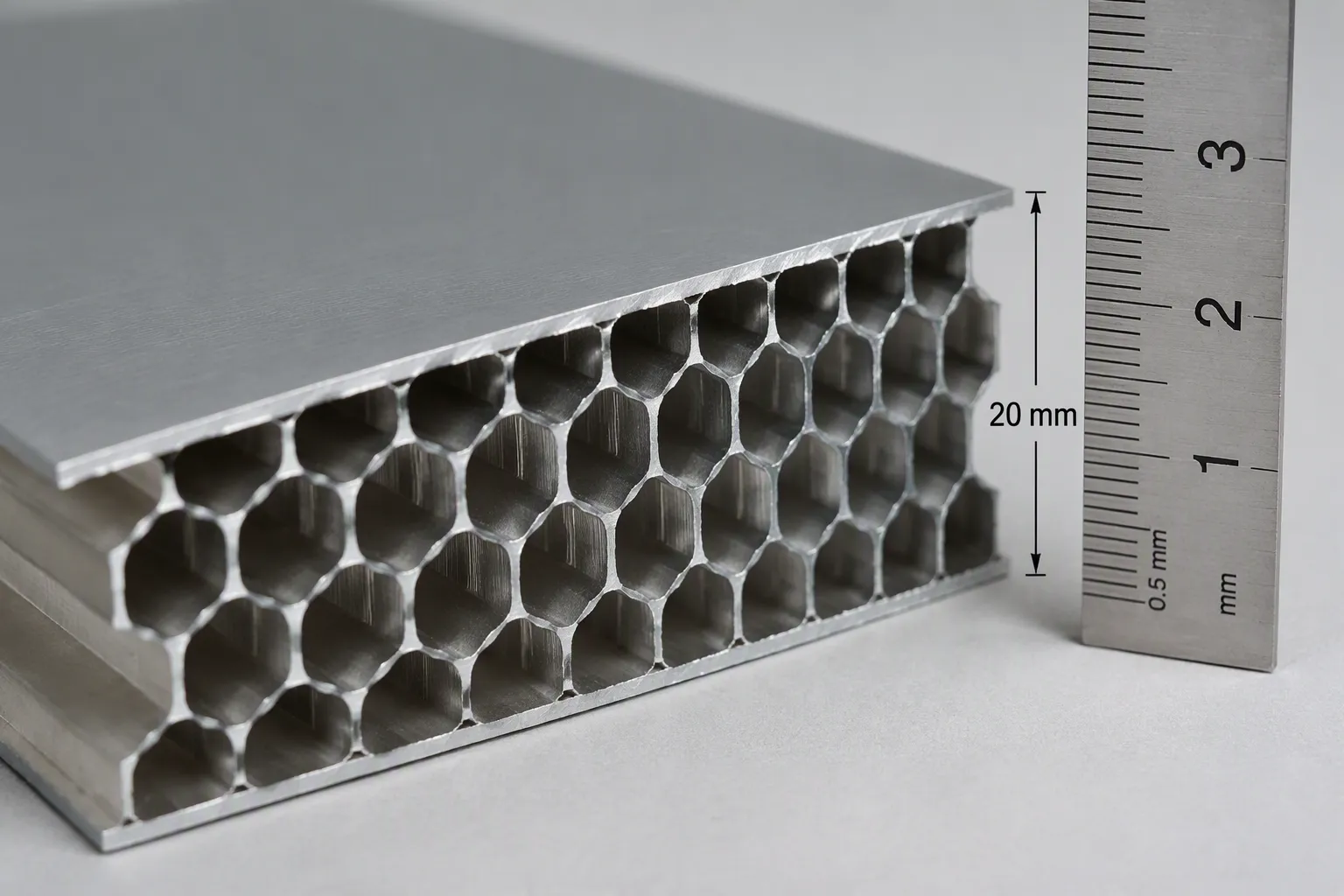
Selecting the right aluminum honeycomb panel for a facade project demands careful evaluation of several interdependent factors. Core thickness, cell density, skin gauge, and coating chemistry each influence structural performance, durability, and cost. Understanding these variables prevents costly specification errors and ensures the material delivers its full potential over decades of service.
Choosing Core Thickness and Cell Density
- Match thickness to span requirements. Increasing core thickness from 10 mm to 20 mm significantly raises the lateral compressive buckling load capacity. This capacity directly correlates with improved span capability—thicker cores resist buckling over longer distances.
- Recognize diminishing returns. The load capacity increase measures approximately 40% when thickness moves from 10 mm to 15 mm. However, the gain drops to only 10% when thickness increases from 15 mm to 20 mm. This plateau effect signals that additional thickness beyond 20 mm yields minimal structural benefit.
- Target the optimal range. Based on cost and performance balance, the recommended core thickness for long-span facade applications falls between 15 mm and 20 mm. This range delivers maximum structural efficiency without unnecessary material expense.
- Scale thickness relative to length. Longer panels—for example, those reaching 500 mm—become more flexible and prone to overall instability failure. The thickness-to-length ratio must remain proportional to maintain span capability. A panel that performs well at 300 mm may fail at 600 mm with the same core thickness.
Cell density, measured by cell size and foil gauge, affects the panel’s compressive strength and impact resistance. Denser cores with smaller cells distribute localized loads more effectively. This characteristic matters for areas subject to hail or accidental impact. For standard curtain wall applications, a conventional cell density provides adequate performance. High-traffic zones or ground-floor installations may warrant denser cores for enhanced protection.
Selecting Skin Material and Coating Systems
The aluminum face skins contribute impact resistance and determine the panel’s visual appearance. Skin gauge—typically ranging from 0.5 mm to 1.0 mm—directly influences dent resistance. Thicker skins withstand greater impact forces without permanent deformation. However, thicker skins add weight and cost. Most facade applications perform well with a 0.5 mm exterior skin. Ground-floor installations or areas prone to vandalism benefit from the 1.0 mm option.
| Feature | PVDF Coating | PE Coating |
|---|---|---|
| Outdoor service life | 20–30 years | 5–8 years |
| Color retention | Excellent (resists fading, chalking) | Moderate (fading after prolonged UV) |
| QUV-B test (gloss retention) | ≥90% after 1,000 hours | ≥30% after 500 hours |
| QUV-B test (color difference ΔE) | ≤2 after 1,000 hours | ≤5 after 500 hours |
PVDF coatings deliver superior weather resistance and color stability. Accelerated testing confirms this advantage. The QUV-B results demonstrate that PVDF maintains gloss and color far better than PE under identical UV exposure. For building facades that must retain their aesthetic appeal for decades, PVDF represents the prudent selection. PE coatings suit interior applications or temporary structures where extended outdoor performance matters less.
Panel size limits also deserve attention during selection. Manufacturing equipment constrains maximum panel dimensions. Large-format panels require specialized presses and autoclaves. Consult your manufacturer early to confirm available sizes for your specific project requirements. This early dialogue prevents design revisions later in the process.
The selection process ultimately determines whether an aluminum honeycomb panel performs as intended. Core thickness, cell density, skin gauge, coating chemistry, and bond quality each contribute to the final result. Architects who invest time in this evaluation reap rewards through superior building performance and reduced maintenance costs. The non-combustible nature of aluminum adds another layer of safety assurance. These panels serve diverse applications across commercial and institutional sectors. Proper material selection transforms a good design into an exceptional, enduring facade.
The aluminum honeycomb panel used for building decorations delivers lightweight strength, perfect flatness, and durability. This material excels in both exterior and interior applications. Aluminum honeycomb panels provide a superior choice for modern facades.
Selection remains critical for achieving optimal results. Core density, skin material, and bonding quality determine long-term performance. Architects must consult specialized manufacturers early in the design phase. This ensures proper load calculations, sample testing, and appropriate panel dimensions for each project.
Aluminum honeycomb panels empower designers to achieve bold, clean facades. They preserve structural integrity while supporting sustainability. The aluminum core provides fire resistance and thermal efficiency. This balance enables creative freedom without compromise.
FAQ
Q: How do aluminum honeycomb panels compare to solid aluminum sheets in cost?
Q: What maintenance do aluminum honeycomb panels require?
Q: Can manufacturers create custom shapes and curved panels?
Q: How does panel weight affect building structural design?
Q: What warranty periods do reputable manufacturers offer?
Post time: Sep-02-2026


