


Engineers optimize mechanical performance and cost efficiency by specifying key parameters. Alloy selection, foil depth, cell size, and cell wall finishing determine structural behavior. Selecting the ideal aluminum honeycomb core provides a superior stiffness-to-weight ratio compared to Nomex or aramid cores. Metallic compatibility and high thermal conductivity also make aluminum the preferred core material.
Unlike organic alternatives, an aluminum composite panel resists extreme thermal stress and environmental degradation. Dense honeycomb geometry distributes loads evenly across large structures. Technical teams require clear criteria when evaluating quality for demanding applications. Project success in architectural cladding, commercial transportation, HVAC systems, and aerospace engineering depends on matching core specifications directly to composite panel requirements.
Key Takeaways
- Match aluminum alloy grades to environmental needs for optimal strength and corrosion resistance.
- Smaller honeycomb cell sizes deliver maximum shear strength and structural support for heavy loads.
- Unexpanded core blocks lower shipping costs and give fabricators custom cutting flexibility.
- Verified ISO certifications guarantee reliable performance and strong adhesive bonding under high stress.
Material Specs for Aluminum Composite Panels
Selecting optimal metal alloys ensures long-term operational success. Engineers choose specific foil grades to match mechanical stress levels and environmental exposures. Proper specification prevents premature material fatigue in heavy-duty structural applications.
Alloy Grades for Aluminum Honeycomb Core
The selection of high-grade aluminum foils dictates structural performance. Grade 3003 serves as the standard commercial choice for general structural panels. Grade 5052 offers higher mechanical properties for demanding engineering applications. Technical teams analyze yield thresholds carefully prior to manufacturing.
| Alloy | Tensile Strength (psi) | Yield Strength (psi) |
|---|---|---|
| 3003 | 17,000 – 23,000 | 13,000 |
| 5052 | 33,000 – 42,000 | 28,000 |
Grade 5052 provides superior load-bearing strength under severe dynamic stress. Structural engineers specify this robust alloy for marine environments and heavy transport vehicle structures. Grade 3003 delivers reliable, cost-effective rigidity for standard architectural cladding projects. Selecting appropriate alloy compositions optimizes project costs while maintaining design margins.
Corrosion Resistance and Surface Treatments
Chemical conversion coatings protect the core material from moisture degradation. Specialized pre-treatments apply anti-corrosion primers directly onto raw foil surfaces prior to adhesive bonding processes. These chemical barriers improve overall weather resistance in severe industrial environments. Proper surface processing extends the operational life of structural components significantly.
The alloy in ACP panels matters a lot. Many panels use alloy AA1100. This alloy has a little magnesium in it. Magnesium helps the aluminum fight corrosion better. You get more protection from salt spray and acid rain. Your panels last longer and keep their color and finish.
Selecting matching metals eliminates galvanic reaction risks across panel assemblies. Dissimilar metals create electrical potential differences in humid operational conditions. Installing an aluminum core alongside matching aluminum skins prevents internal galvanic decay completely. This mechanical alignment improves overall bond durability and preserves structural quality over extended operational lifespans. Every aluminum composite panel benefits from unified metallic properties. Modern aluminum composite panel designs maintain long-term structural integrity. The resulting honeycomb structure resists harsh outdoor elements effectively without delamination risks.
Density and Geometry of Aluminum Honeycomb Core
How Cell Size Impacts Mechanical Strength
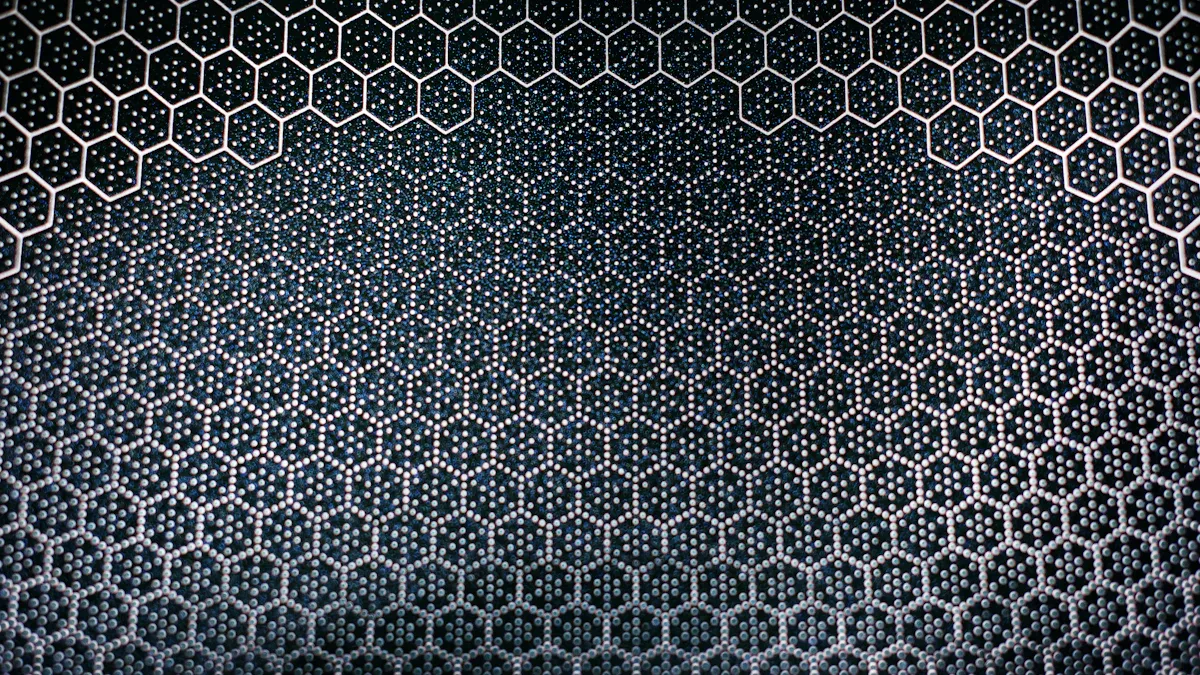
Core density and internal geometry dictate overall mechanical performance in lightweight sandwich panels. Cell dimensions directly control core density, weight, and shear resistance. Smaller cell sizes create higher cell wall density per square unit. This concentrated geometric pattern elevates flatwise compressive resistance across the structural face. Project engineers analyze yield stress thresholds carefully to match core geometry with specific mechanical requirements.
Shear resistance correlates directly with specific cell dimensions:
- 3.2 mm (1/8 in) cells: highest shear strength (smallest cell size)
- 6.4 mm (1/4 in) cells: intermediate shear performance
- 9.5 mm (3/8 in) cells: lowest shear strength (largest cell size)
Design teams choose larger cell geometries when project specifications require lower material weight and moderate shear capacity. Smaller cell options deliver maximum load distribution for heavy-duty engineering applications. Selecting the correct cell diameter ensures balanced structural efficiency, optimal weight savings, and consistent stability across highly demanding operational environments.
Foil Thickness and Load-Bearing Capacity
Foil wall thickness determines maximum load capacity and long-term panel integrity. Thicker aluminum foil walls reinforce hexagonal cell nodes against severe directional forces. Dense cell walls act like microscopic vertical structural I-beams. They distribute external mechanical pressure uniformly across the core material.
The hexagon cells spread force across the panel. This design helps the panel resist bending, warping, and impacts.
Increasing foil thickness adds necessary structural rigidity without adding excessive physical weight to the final assembly. Proper wall geometry maintains consistent dimensional tolerances relative to total panel thickness. Specialized open-cell honeycomb geometry also abates thermal expansion, suppresses acoustic vibration, and optimizes directional airflow in high-efficiency HVAC cooling systems. Technical teams specify an engineered aluminum honeycomb core to ensure long-term surface flatness and geometric accuracy. Every finished honeycomb panel retains exceptional load resistance and operational reliability under harsh working conditions.
Structural Requirements for Aluminum Honeycomb Panels
Core Depth and Panel Thickness Guidelines
Engineers specify custom dimensions based on operational demands across different industries. Architectural cladding relies on standard core depths to maintain long-term surface flatness over broad building facades. Commercial transportation systems use thicker core dimensions to absorb continuous dynamic stress and physical impacts. Aerospace structures demand exact panel thickness parameters to achieve severe weight savings without sacrificing structural integrity. Industrial equipment frames require specialized core profiles for heavy-duty performance under heavy static loads. Every aluminum honeycomb panel engineered for these sectors requires exact dimensional control to ensure reliable daily operations.
Matching core depth to total panel thickness ensures predictable load distribution across composite structures. Precision slicing holds cell wall height consistent across large manufacturing batches. Standard thickness tolerance settings reach ±0.1 mm for normal commercial production. High-precision aerospace orders achieve tighter tolerances of ±0.05 mm. Additionally, unexpanded slices achieve a thickness tolerance of ±0.125 mm for 3 mm slices. Specifying exact geometric parameters protects each finished assembly against structural warping and mechanical failure.
Matching Supply Formats to Manufacturing Needs
Manufacturers select core supply formats based on production volume and shop capabilities. Available supply formats include expanded sheets, custom slices, perforated variants, and unexpanded compressed blocks. Expanded sheets allow immediate placement into a finished honeycomb panel without extra shop prep work. Perforated honeycomb options facilitate internal gas venting and uniform air movement during laminate bonding processes. Custom slices deliver ready-to-use core material directly to active assembly lines for immediate installation.
Chenshou Tech supplies unexpanded compressed blocks to optimize transport efficiency and lower shipping costs significantly. Compressed blocks occupy minimal container space during transport over long overseas distances. Fabricators cut these dense honeycomb blocks into exact slices with a cutting tolerance of +/- 0.1 mm (+/- 0.004″). This versatile supply format provides maximum cutting flexibility for high-volume production lines. Manufacturers preserve product quality while reducing material waste across every aluminum honeycomb core order. Ultimately, selecting the proper aluminum honeycomb panel configuration optimizes overall manufacturing profits.
Evaluating Quality in High-Quality Aluminum Honeycomb Panels
Critical Quality Standards and Manufacturing Precision
Manufacturing precision dictates overall structural integrity in core production. Quality inspection processes start with raw foil examination and end with final node evaluation. Skilled technicians evaluate adhesive distribution along each node line to prevent core delamination under severe stress. Precise core expansion creates uniform cell geometry across the entire matrix. Clean cutting equipment produces sharp, burr-free cell wall nodes. These smooth edges ensure continuous surface contact during face sheet bonding. High bond strength preserves total panel durability during heavy daily operations.
Engineers verify core structural performance through standardized mechanical testing procedures. Standardized testing guarantees predictable mechanical behavior across demanding engineering applications.
| Test Type | Standard(s) | Typical Requirements / Notes |
|---|---|---|
| Shear Strength | ASTM D1002 | Minimum shear strength: 2,500 psi (17.2 MPa) at room temp. |
| Peel Strength | ASTM D1781 | Minimum peel strength: 8–15 lbf/in (1.4–2.6 N/mm). |
| Structural Properties | ASTM C393 | Evaluates overall sandwich panel performance. |
Chenshou Tech maintains rigorous manufacturing control to deliver consistent composite core materials. Third-party testing validates exact core properties across production batches.
ISO 9001:2008 and CE EN Certificates are listed among the certifications for aluminum honeycomb core manufacturing.
Common Selection Mistakes to Avoid
Selecting core materials requires balanced mechanical analysis. Buyers often commit costly design errors during the specification process. Over-specifying foil thickness unnecessarily increases total weight and material costs. Ignoring node bond strength leads to internal core shearing under cyclic loading conditions. Miscalculating environmental loads causes premature adhesive degradation in high-humidity applications. Buyers must evaluate temperature exposure, dynamic flexural stress, and moisture levels before selecting final core dimensions.
Working with experienced manufacturers ensures optimal structural quality for specialized projects. Chenshou Tech provides custom-engineered core solutions matching international safety standards. Expert engineers assist technical teams with accurate alloy matching and exact density calculations. Proper selection secures long-term quality while maximizing economic value. Specifying a high-quality aluminum honeycomb panel guarantees superior impact absorption for modern transit vehicles. Installing a high-quality aluminum honeycomb panel protects building cladding against extreme wind pressures. Purchasing an aluminum honeycomb panel from an established supplier ensures reliable field performance across demanding structural applications.
Selecting the ideal aluminum honeycomb core requires balancing alloy selection, geometric density balance, supply format efficiency, and manufacturing precision. Engineers optimize mechanical performance by verifying node bond strength and foil specifications for every structural composite panel.
Buyers should evaluate these core selection criteria prior to placing orders:
- Match alloy grades directly to environmental exposure demands.
- Balance cell size and foil wall thickness for required shear strength.
- Confirm international ISO and CE standards to verify product quality.
Specifying a high-quality aluminum honeycomb panel guarantees structural integrity across demanding applications. Contact Chenshou Tech specialists today to request custom core cuts, material samples, and technical consultations for your engineering projects.
FAQ
Q: What is the main structural advantage of an aluminum honeycomb core?
An aluminum honeycomb core provides a superior stiffness-to-weight ratio. The dense hexagonal geometry acts like vertical beams, distributing mechanical pressure uniformly across the surface. This structural behavior prevents surface warping and maximizes overall panel stability under heavy loads.
Q: How does core selection affect composite panel durability?
Selecting matching aluminum alloys prevents internal galvanic decay in humid conditions. Proper pre-treatments, such as chemical conversion coatings and primers, protect core surfaces against corrosion. These choices enhance overall structural durability and eliminate long-term delamination risks under extreme environmental stress.
Q: Why do fabricators prefer purchasing unexpanded compressed blocks?
Unexpanded compressed blocks occupy minimal container space during transport. This supply format reduces shipping costs significantly. Fabricators also gain maximum cutting flexibility, slicing custom core depths with tight tolerances to ensure product quality for high-volume manufacturing lines.
Q: Which standards verify the performance of an aluminum honeycomb panel?
Manufacturers evaluate structural properties using recognized test standards. ASTM D1002 measures shear strength, while ASTM D1781 checks peel strength. Sandwich structures undergo testing via ASTM C393. Facilities certified to ISO 9001:2008 standards build every aluminum honeycomb panel to ensure consistent mechanical performance.
Post time: Aug-21-2026


