


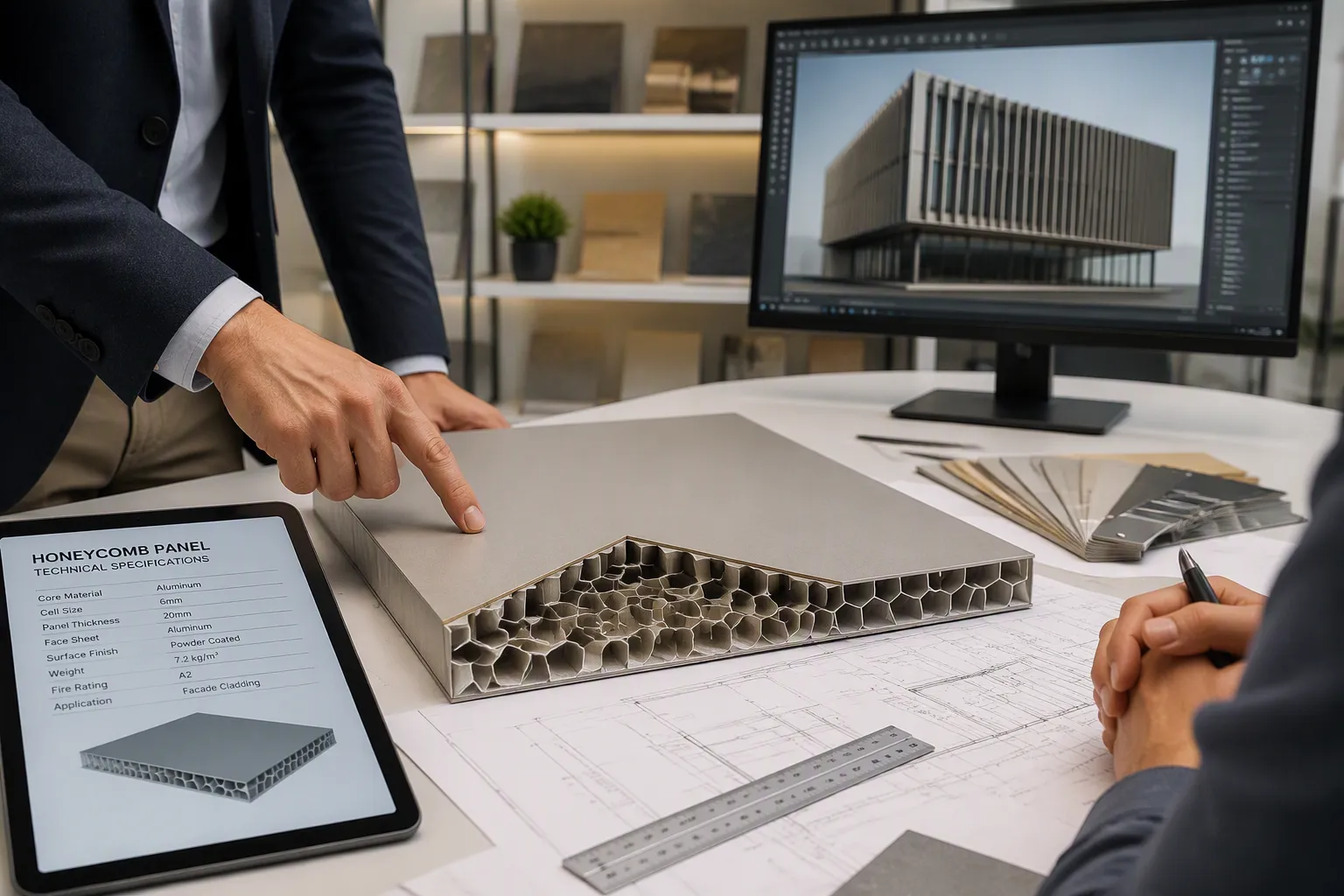
You need a material that is both lightweight and strong. A honeycomb panel delivers exactly that. Its sandwich structure, inspired by aerospace design, offers an exceptional strength-to-weight ratio. But how do you sift through the options to find the perfect match for your build? The right choice hinges on balancing material, core geometry, and application demands. We’ll guide you through the essential factors and a practical selection process to ensure your project’s success. From structural integrity to aesthetic appeal, every decision impacts performance. Consider your project needs carefully, whether for architectural facades or interior lighting features. Understanding these fundamentals helps you choose wisely across diverse applications.
Key Takeaways
- Select core material based on strength, fire resistance, and moisture tolerance.
- Match cell size and panel thickness to your load and span requirements.
- Weigh total lifecycle cost, not just upfront price, for best value.
- Verify supplier quality through certifications and sample testing.
Honeycomb Panel Basics
What Defines a Honeycomb Panel?
A honeycomb panel is a sandwich structure built from two thin, high-strength face sheets bonded to a thicker, lightweight core. This design traces its origins to aerospace engineering, where every ounce matters. The result is an exceptional strength-to-weight ratio that makes these panels valuable across many industries. The core’s hexagonal cells resemble a natural beehive, and this geometry is not accidental. Each cell wall supports its neighbors, creating a structure that resists compression and shear forces efficiently. Under impact loads, the core absorbs and dissipates energy through elastic or plastic buckling, protecting the panel’s overall integrity.
The sandwich concept works because the core separates the face sheets, increasing the panel’s bending stiffness dramatically without adding significant weight. This eliminates the need for external stiffeners or heavy framing. For applications where weight reduction matters—such as high-speed rail interiors, aircraft flooring, or even architectural lighting features—this structural efficiency proves invaluable. The thin face sheets handle in-plane loads, while the core resists out-of-plane forces and prevents the skins from buckling under compression.
Core Components: Skins and Core
The face sheets, or skins, provide the panel’s surface strength and durability. Common skin materials include aluminum, which offers excellent corrosion resistance and recyclability. Some panels use stone veneers or carbon fiber for specialized applications. The skins bond to the core through processes like autoclave curing, press bonding, or vacuum bag techniques. These methods ensure a strong, lasting connection between layers.
The core material determines much of the panel’s performance. Aluminum honeycomb cores deliver the best strength-to-weight ratio among core options. Nomex aramid cores provide superior fire resistance, making them suitable for demanding environments. The core’s cell size and density directly affect stiffness and load capacity. Medium cells, such as 12.7mm or 9.5mm, balance strength, weight, and cost for most projects. Smaller cells, down to 1.6mm, increase density and strength for demanding applications. HexWeb® honeycomb cores come in various configurations, including regular hexagonal, over-expanded, and flexcore designs, each tailored to specific structural needs. This versatility allows engineers to match the core material precisely to their project’s requirements, whether for architectural facades, marine bulkheads, or interior partitions.
Key Selection Criteria
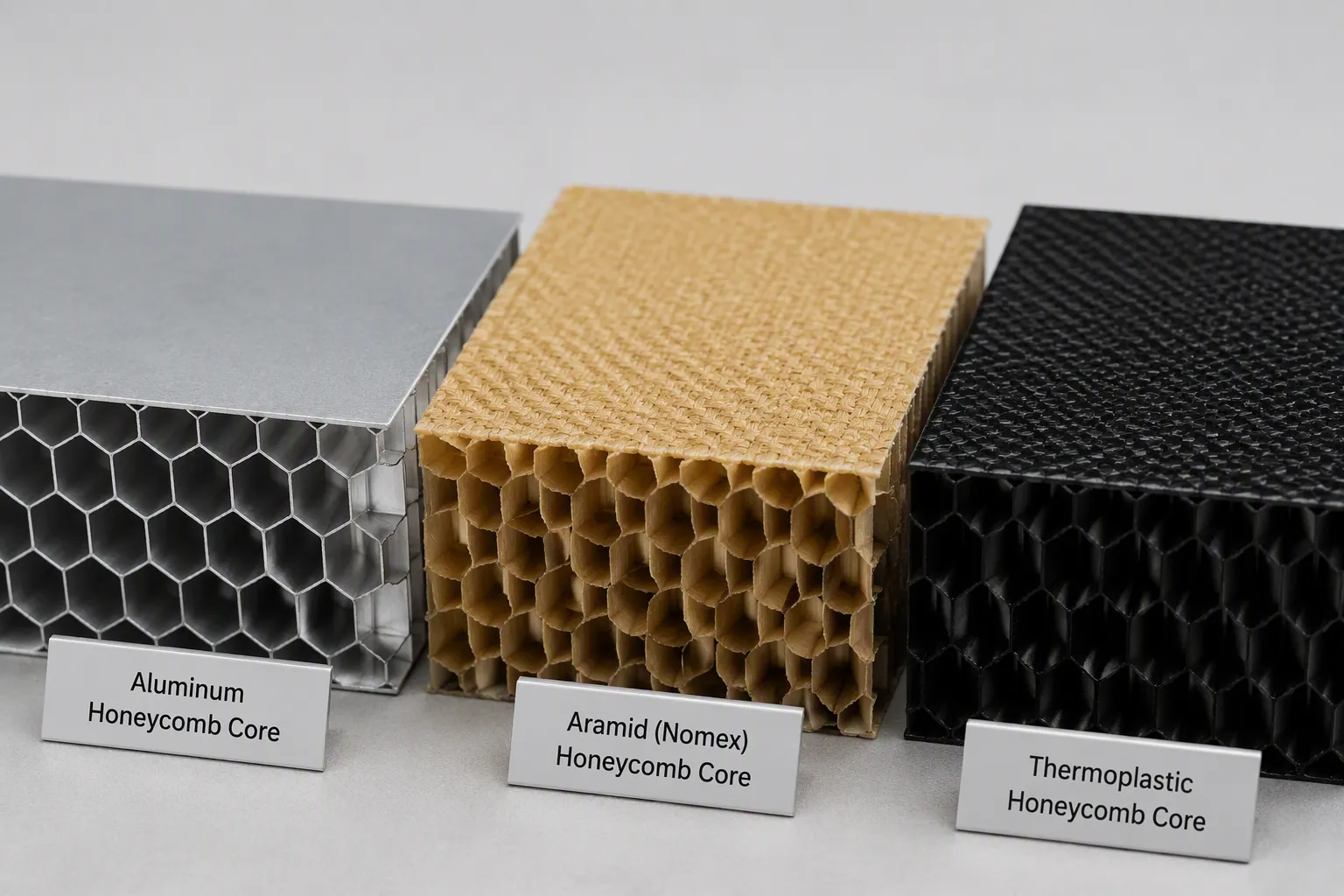
Material Choices: Aluminum, Aramid, and Thermoplastic
The core material you select governs the panel’s performance across weight, strength, fire resistance, and moisture tolerance. Three core materials dominate the market: aluminum, aramid, and thermoplastic.
Aluminum honeycomb cores stand out as the most popular choice. They offer high strength while remaining lightweight. Aluminum naturally resists corrosion and does not absorb moisture. It is also fully recyclable, supporting sustainability goals. For applications that demand fire resistance, aluminum performs well since it is non-flammable and withstands high temperatures. These properties make aluminum honeycomb panels suitable for building facades, ceilings, and interior partitions.
Aramid cores, such as Nomex, deliver exceptional strength-to-weight ratios. The evidence shows that aramid honeycomb core material has a strength that is five times that of steel of the same quality, yet its density is only one-fifth of steel. This makes it a lightweight high-strength structural material. Aramid cores also provide fire-resistant properties, making them suitable for aerospace and rail applications where fire safety standards like FAR 25.853 or EN45545 must be met. However, aramid cores are more moisture-sensitive compared to aluminum or thermoplastic.
Thermoplastic honeycomb cores offer different advantages. They are extremely light and do not corrode. Thermoplastic cores are inherently waterproof, making them superior to aramid paper cores in moisture-prone environments. They also excel at absorbing and dissipating impact energy. Fire resistance varies by polymer type, with some thermoplastics handling temperatures up to 240-260°C. Many thermoplastic types are recyclable as well.
The table below summarizes the key mechanical properties:
| Property | Aluminum Honeycomb Core | Thermoplastic Honeycomb Core |
|---|---|---|
| Weight | Lightweight | Extremely light |
| Strength | High strength | High strength with excellent stiffness |
| Corrosion Resistance | Naturally corrosion resistant | Does not corrode |
| Fire Resistance | Non-flammable, withstands high temperatures | Varies by polymer |
| Moisture Resistance | Does not absorb moisture | Inherently waterproof |
| Recyclability | Recyclable | Many types are recyclable |
Core Size and Thickness for Honeycomb Panels
Beyond core material, the geometry of the core plays a critical role. Two key parameters determine panel performance: cell size and panel thickness. The chosen core material also affects the optimal balance between these parameters.
Typical panel thickness ranges from 8mm to 50mm. Thicker panels provide greater bending stiffness and load capacity. For example, a 50mm thick panel resists deflection far better than an 8mm panel under the same load. The choice of panel thickness depends on the span and weight requirements of your project. A thicker panel also improves acoustic performance, making it suitable for soundproof ceilings in lighting-controlled environments. Architectural lighting features benefit from the flatness and stability of these panels.
Cell size typically ranges from 4mm to 12mm for aluminum honeycomb cores. Smaller cells, such as 4mm, pack more wall material per area. This increases compressive strength, shear strength, and impact resistance. Larger cells, such as 12mm, reduce weight and cost but lower mechanical performance. The following table shows the trade-offs:
| Property | Smaller Cell Size | Larger Cell Size |
|---|---|---|
| Compressive Strength | Higher | Lower |
| Shear Strength | Higher | Lower |
| Impact Resistance | Greater | Lower |
| Stiffness | Higher | Lower |
| Weight | Heavier | Lighter |
| Cost | More expensive | More cost-effective |
The directional behavior of the core also matters. When the load is parallel to the cell walls, the core delivers its highest strength and stiffness. Engineers must consider load direction when designing the panel orientation.
Cost is another factor. Selecting the right honeycomb panel requires balancing these factors. An aluminum honeycomb panel typically ranges from $50 to $120 per square meter, depending on core density, cell size, and overall dimensions. This is higher than aluminum composite panels (ACP) at $20–$60 per square meter. However, the long-term value of aluminum honeycomb panels is strong. They last 20–30 years with minimal risk of warping or deformation. Their lighter weight reduces installation costs by about 30% compared to steel. Recyclability further lowers end-of-life costs. Over the building’s lifespan, the total cost of ownership for aluminum honeycomb panels is more favorable due to efficient installation, reduced structural support needs, and minimal maintenance.
Application-Specific Considerations
High-Strength Needs: Aerospace and Transportation
The aerospace and transportation sectors demand materials that reduce weight without sacrificing structural integrity. Honeycomb panels excel in these environments because their sandwich construction mimics an I-beam, delivering excellent bending strength at a fraction of the weight of solid materials. In high-speed rail, these panels form ceilings, side walls, and load-bearing floors. Replacing traditional metal with fiberglass or carbon fiber composite panels reduces weight by over 30%. This reduction improves acceleration, cuts energy consumption, and lowers operational costs. The panels also dampen vibrations, enhancing passenger comfort during travel. Aircraft flooring relies on the same principle, where every kilogram saved translates directly into fuel savings. The hexagonal core structure provides the rigidity needed to withstand repeated loads while keeping the overall density remarkably low.
Architectural and Construction Applications
Architects value honeycomb panels for their design flexibility and aesthetic range. Panels can be fabricated flat or curved, opening possibilities for facades, canopies, and interior feature walls. The surface finish plays a major role in the final appearance and durability. The table below compares common finish options:
| Finish Type | Durability & Suitability |
|---|---|
| PVDF Coating | Highly durable; resistant to weathering, UV radiation, and chemicals; popular for exterior architectural applications, ensuring long-lasting color and gloss. |
| PE Coating | More economical; suitable for interior applications where less extreme weather exposure is expected. |
| Anodized Finish | Creates a protective oxide layer enhancing corrosion resistance; suitable for public buildings and clean environments. |
| Stone Veneer | Real stone or marble bonded to an aluminum honeycomb base; reduces weight without sacrificing luxury appearance; used in hotel lobbies and luxury retail walls. |
Stone veneer panels weigh up to 70% less than solid stone, reducing substructure costs while maintaining a premium look. For acoustic performance, perforated panels combined with sound-absorbing materials create effective soundproof ceilings and partitions. These primary applications of honeycomb panels also include marine environments, where rot-proof and lightweight properties prove critical for boat flooring and bulkheads. The transport industry uses the same panels for wall linings, cabinetry, and internal modules. Honeycomb louvers offer additional light control options for architectural facades, allowing designers to manage natural lighting while maintaining structural performance. Whether for a 55-story tower with stone-faced cladding or a building-integrated photovoltaic facade, these panels deliver reliable performance across diverse applications. The combination of flatness, strength, and finish options makes them a versatile choice for modern construction projects.
Selecting a High-Quality Aluminum Honeycomb Panel

Defining Your Project’s Requirements
Before contacting any supplier, you must define your project’s key parameters. Start with load-bearing needs. Calculate the maximum weight the panel will support, including dynamic loads from wind or vibration. A curtain wall facade demands different structural performance than an interior ceiling panel. Write down the span between supports and the deflection limit you can tolerate. These numbers will drive your core density and panel thickness choices.
Next, assess environmental exposure. Humidity, temperature swings, UV radiation, chemical contact, and mechanical impact all affect material selection. Aluminum honeycomb panels resist corrosion naturally and perform well in moderate humidity. However, highly corrosive environments, such as coastal areas with salt spray, require careful selection of aluminum alloys and protective coatings. For outdoor transportation equipment exposed to rain, road salt, and temperature changes, thermoplastic cores and corrosion-resistant skins offer better protection. Installation conditions matter too. Install panels only when the temperature stays above 5°C. Excessively humid conditions can affect adhesive curing and material expansion properties.
Aesthetic preferences shape your finish selection. PVDF coatings provide excellent weather resistance for exterior facades. PE coatings offer a cost-effective option for interior spaces. Stone veneer surfaces deliver a premium look at a fraction of solid stone weight. Consider how the panel will appear under different lighting conditions. The surface finish affects light reflection and color consistency across large installations.
Finally, set a realistic budget. A high-quality aluminum honeycomb panel costs more upfront than alternatives like aluminum composite panels. However, the long-term value justifies the investment. These panels last 20–30 years with minimal maintenance. Their lightweight nature reduces installation costs by about 30% compared to steel. Factor in the total cost of ownership, not just the purchase price.
Matching Specifications to Your Shortlist
Once you define your requirements, evaluate potential suppliers against objective criteria. Manufacturer reputation matters significantly. Look for certifications that demonstrate quality management and product compliance. A reputable manufacturer should hold ISO 9001 for quality management systems. CE marking indicates conformity with European health, safety, and environmental standards. SGS certification provides third-party verification of product quality. RoHS compliance ensures the panel contains no hazardous substances. For fire safety, EN 13501-1 classification A2-s1, d0 confirms the panel meets strict non-combustibility standards.
Request technical data sheets from each shortlisted manufacturer. Verify dimensional tolerances carefully. High-quality panels maintain flatness within ±0.008 inches per radial foot. Panel thickness should stay within ±0.015 inches. Length and width tolerances should not exceed ±0.125 inches. These specifications ensure consistent installation and a clean final appearance. Lamination on a Grade AA granite surface plate, holding a flatness tolerance of 0.0005 inches, guarantees flatness even on the largest panels.
Ask about the manufacturer’s production process. Precision cold pressing and hot pressing technologies produce stronger bonds between skins and core. Closed-edge box structures improve tightness and safety. Corner codes and screws replace traditional welding, creating a nail-free surface that simplifies installation.
Before committing to a full order, request samples from your top two suppliers. Test each sample for flatness, finish quality, and ease of installation. Measure surface roughness and height variation. A quality panel shows consistent surface texture without deep pores or irregularities. Compare samples side by side under similar lighting conditions. Install a test panel to verify that corner fittings align properly and the panel mounts securely. This hands-on evaluation reveals issues that specifications alone cannot capture.
The right high-quality aluminum honeycomb panel combines verified specifications with proven manufacturer reputation. By following this systematic approach, you select a panel that meets your performance requirements and budget constraints. Your project gains a durable, lightweight solution that performs reliably for decades across diverse applications.
Choosing the right honeycomb panel requires balancing material, core size, thickness, and application demands. Avoid common mistakes like selecting thickness by price alone or ignoring cell size. Total lifecycle cost matters more than upfront panel price. A systematic approach evaluates manufacturer quality, technical support, and logistics factors. By applying these criteria, you can confidently select a panel that meets your performance and budget goals. Use the outlined steps and consult suppliers for expert guidance. The right panel enhances your project’s longevity, efficiency, and lighting integration for architectural features. Proper lighting considerations ensure optimal panel performance.
FAQ
Q How do I install aluminum honeycomb panels?
Installation uses corner codes and screws instead of welding. This method creates a clean, nail-free surface. The lightweight nature of the panels allows fixing with ordinary binders. A unitized curtain wall system enables efficient assembly. No heavy equipment is required, which reduces labor costs significantly.
Q Can these panels be curved or shaped?
Yes. Manufacturers can fabricate honeycomb panels in flat or curved configurations. This flexibility supports creative architectural designs for facades, canopies, and feature walls. The hexagonal core structure maintains stability even in curved forms. Designers gain freedom to create distinctive building elements without sacrificing structural performance.
Q What maintenance do honeycomb panels require?
Aluminum honeycomb panels need minimal upkeep. The surface resists corrosion and does not absorb moisture. Standard cleaning with mild soap and water maintains appearance. PVDF coatings protect against weathering and UV radiation for decades. Panels typically last 20–30 years without warping or deformation, reducing long-term maintenance costs.
Q How do honeycomb panels perform in fire situations?
Aluminum honeycomb cores are non-flammable and withstand high temperatures. This property makes them suitable for building facades and interior partitions. For stricter requirements, aramid cores provide enhanced fire resistance. Panels meet standards like EN 13501-1 classification A2-s1, d0 for non-combustibility. Fire safety performance depends on the specific core material selected.
Q Can I integrate lighting features with these panels?
Yes. The flat, stable surface of honeycomb panels supports integrated lighting designs. Perforated panels combined with sound-absorbing materials work well for acoustic ceilings with embedded fixtures. The panels’ dimensional stability prevents sagging around lighting elements. Architects commonly use them for illuminated feature walls and modern ceiling installations.
Post time: Aug-25-2026


