


For international sandwich panel manufacturers, facade fabricators, and composite engineers, purchasing aluminum honeycomb core involves a critical logistics decision: which supply form offers the lowest total landed cost? Because an expanded honeycomb core is predominantly empty air, shipping fully expanded sheets across oceans incurs massive volumetric freight penalties. Sourcing unexpanded (compressed) slices or solid honeycomb blocks allows manufacturers to reduce ocean container volume by up to 80% to 85%, significantly lowering procurement overhead.
- Volumetric Freight Savings: Unexpanded (compressed) slices deliver an expansion ratio between 1:20 and 1:35, allowing a single 40HQ container to carry up to 50,000–65,000 m² of core material versus only 6,000–8,000 m² in expanded form.
- Transit Damage Prevention: Compact compressed slices are inherently rigid, eliminating crushed cell edges and corner creases commonly experienced with expanded sheets.
- Tooling Investment Payback: For panel fabricators, simple manual pullers or semi-automatic expansion tables offer a swift ROI, often recouped within the freight savings of 1 to 2 ocean containers.
- Application Matching: Sourcing unexpanded slices is best for high-volume ocean shipping; solid blocks suit facilities with horizontal CNC saws; expanded sheets fit local prototyping and fast-turnaround jobs.
Understanding the Three Supply Forms of Aluminum Honeycomb Core
In advanced composite engineering, aluminum honeycomb core structures are manufactured through precision foil roll printing, epoxy node line gluing, stacking, hot-press curing, and precision slicing. Depending on the buyer’s processing capabilities and geographic distance from the factory, the material is supplied in three distinct formats:
1. Unexpanded / Compressed Honeycomb Slices (HON-SLI) — Optimal for Export
Compressed slices are cut directly from cured honeycomb blocks using high-precision horizontal saws to the buyer’s specified core thickness (e.g., 6 mm, 10 mm, 15 mm, 25 mm ±0.1 mm). The slices remain unexpanded in compact strip form. Once received at the buyer’s destination plant, they are expanded mechanically into hexagonal honeycomb meshes ready for lamination.
2. Solid Honeycomb Blocks (HON-BLK) — For In-House CNC Slicing Facilities
Honeycomb blocks represent the cured, uncut multi-layer foil blocks before precision slicing. Sourcing unexpanded blocks offers maximum flexibility for large-scale composite fabricators who maintain dedicated horizontal band saws, allowing them to slice variable thicknesses on demand for diverse custom projects.
3. Expanded Honeycomb Core (HON-EXP) — Ready-to-Use Sheets
Expanded honeycomb core is fully pulled and calibrated into standard geometric sheets (such as 1220 × 2440 mm or 1500 × 3000 mm) at the manufacturing plant. It requires zero on-site expansion equipment and is ready for immediate adhesive coating and skin lamination. However, its expansive volume makes long-distance international container shipping uneconomical.

Ocean Freight Economics: 40HQ Container Loading Analysis
To understand the cost impact, consider a typical international shipment of 15 mm core thickness (1/4″ cell size, AA3003 alloy). The table below outlines typical industry baseline figures for a standard 40-foot high-cube (40HQ) ocean container:
*Note: Exact container square-meter capacity and expansion ratios vary based on specific cell size (e.g., 1/4″, 3/8″, 1/2″) and foil thickness. Cheonwoo provides customized loading calculations per client specifications.
How to Expand Compressed Honeycomb Slices on Site
Expanding unexpanded honeycomb slices into regular hexagonal cells is a straightforward mechanical operation. Depending on factory throughput, fabricators utilize two primary expansion approaches:
- Manual / Pneumatic Pulling Frame: A dedicated clamping table where the top and bottom edge foils of the unexpanded slice are clamped into gripping jaws. The operator pulls the slice along the expansion axis (L-direction) manually or via pneumatic cylinders until the calibrated sheet length is achieved. (Best for: Custom architectural projects < 3,000 m²/month).
- Automatic Roller Expansion Line: Continuous motorized pin-roller units that feed unexpanded honeycomb slices continuously, expanding and flattening the core automatically into exact dimensional tolerances before direct in-line adhesive application. (Best for: Continuous composite production lines > 10,000 m²/month).
Post-Expansion Quality Inspection Checklist (E-E-A-T Standards)
To ensure mechanical properties comply with ASTM C365 compressive and ASTM C273 shear standards, perform the following verification steps after pulling:
- Cell Regularity & Symmetry: Inspect the expanded mesh under standard illumination. Hexagonal cell angles should remain symmetrical (±5% tolerance) without over-stretching or cell collapse.
- Node Line Integrity: Ensure high-temperature epoxy node bonds exhibit zero splitting, slippage, or micro-cracking during full mechanical extension.
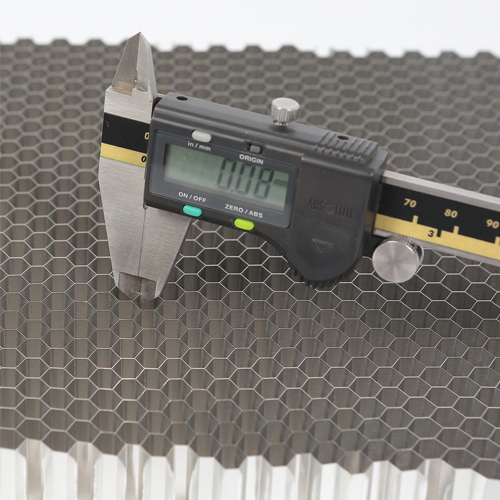
- Thickness Tolerance: Measure slice thickness across multiple points with a digital caliper to verify consistent foil height within ±0.1 mm for optimal skin bonding.
- Surface Flatness: Ensure no localized burrs or edge rolling occur that could interfere with vacuum bagging or continuous hot-press lamination.
Frequently Asked Questions (FAQ)
Q: Do we need expensive automated machinery to expand honeycomb slices on site?
A: No. Most small-to-medium composite workshops build or procure simple manual expansion frames using clamping bars or pneumatic assists. Because the expansion requires only linear tension along the L-direction, capital expenditure is minimal compared to the massive recurring freight savings achieved on every container shipment.
Q: What is the warehouse storage shelf life for unexpanded honeycomb slices?
A: Stored in a dry, climate-controlled warehouse in their original moisture-barrier packaging, unexpanded honeycomb slices have an extended shelf life of over 12–24 months. The high-performance thermoset epoxy node adhesives remain fully stable and retain full mechanical bonding properties prior to expansion.
Q: Can Shanghai Cheonwoo provide customized slice thicknesses and calibrated expansion ratios?
A: Yes. Shanghai Cheonwoo Technology manufactures custom-calibrated unexpanded slices tailored to exact panel dimensions. We provide technical calibration sheets detailing exact pulling lengths ($L_0$ to $L$), cell geometries, and container packing optimizations for 20GP, 40GP, and 40HQ configurations.
Post time: Nov-06-2026


