


Aluminum honeycomb panels meet EN 45545-2 HL2 and HL3 requirements. An all-metal, non-combustible build plus compliant adhesives makes this possible. The sandwich structure also gives bending stiffness close to 100% of that of solid aluminum at equal weight. Rogers Corp notes that EN 45545-2 sets rules for flame spread, heat release, smoke density, and toxic gases.
Engineers and procurement specialists face one question. Can a single material meet fire code and weight targets without losing flatness, acoustics, corrosion resistance, or cost? Huaalu reports that honeycomb surface density reaches only 30%–40% of a solid plate. This Honeycomb Panel article covers specifications, application fit, fabrication, compliance evidence, and cost-effectiveness for rolling stock interior programs.
Lightweighting in Rail Transit
Mass, Energy, and Infrastructure Effects
Every kilogram a train carries takes energy to speed up, stay at speed, and stop. So cutting mass pays off over the whole trip. A lighter train pulls less traction current when it speeds up. It also sends less kinetic energy back to the braking system, which means less brake wear. Metro trains stop often, so speeding up uses most of the energy. High-speed trains fight air drag at cruise, but their speeding-up phases still reward lower mass. Track wear follows the same logic. Lower axle loads mean weaker dynamic forces on rails, sleepers, and switches. Infrastructure maintenance budgets react directly to those forces. Payload capacity completes the picture. A lighter car body and interior leave more of the axle limit open for passengers and luggage.
Interiors as the Weight Reduction Frontier
Interior systems are a high-leverage target for cutting mass. Floors, sidewalls, ceilings, doors, and partitions fill a large share of each car. Traditional solid laminates and steel assemblies add up fast across a full trainset. Aluminum honeycomb panels change that math. Huaalu reports that honeycomb surface density reaches only 30%–40% of a solid plate. So a designer can cut interior mass without making structural sections thinner. The sandwich construction also protects stiffness. Bending stiffness runs close to 100% of that of solid aluminum at equal weight. Flatness and acoustic performance stay steady as mass falls. Procurement teams get a second benefit. Standard panel formats and modular partitions make installation simpler and shorten fit-out time. Interior lightweighting thus delivers savings in energy, track maintenance, and assembly labor all at once.
Honeycomb Panel Advantages
Strength-to-Weight and Stiffness
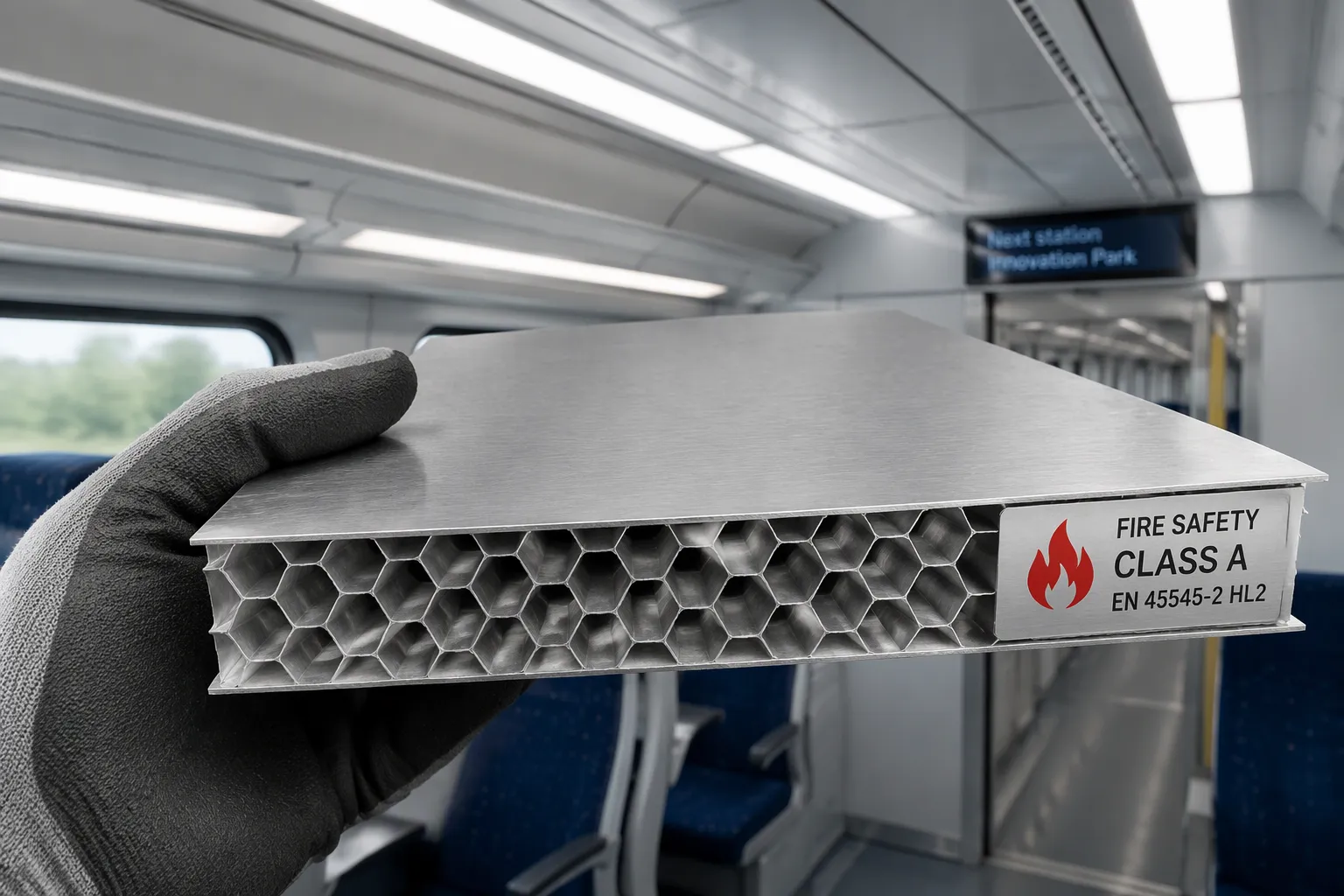
Two thin aluminum face sheets bond to an aluminum honeycomb core. This sandwich structure carries load the way an I-beam does. The skins take tension and compression, and the core holds them apart. The result is bending stiffness close to 100% of that of solid aluminum at equal weight. A designer can therefore hit a stiffness target with far less mass, or raise stiffness without adding kilograms. Mass savings add up across a trainset. A hundred square meters of interior paneling drops real weight, and that weight leaves the axle load budget open for seats, luggage, and passengers. Flatness comes from the same geometry. The core supports the skins at close intervals, so the surface resists oil-canning and stays true across large spans. Rail interiors demand this quality. A wavy ceiling panel or a floor that bends underfoot reads as a defect to passengers and inspectors alike. The Honeycomb Panel holds its shape through vibration and thermal cycling, which keeps door tracks and mounting interfaces aligned over years of service.
Fire, Flatness, Acoustic, and Corrosion Behavior
Fire performance starts with chemistry. Aluminum skins do not burn, and the core is all metal. Zhejiang QianGe Construction Engineering reports that its panels are Class A fire-rated under GB 8624, with non-combustible skins and cores treated with flame-retardant coating where required. The Honeycomb Panel also carries a B1 fire rating, a classification that reflects limited flame spread. Smoke density and toxicity indices meet EN 45545-2 HL2, the hazard level widely adopted in the industry. Inorganic cores and facings reinforce this behavior. They add no fuel to the fire load and help the panel form a refractory layer. UIC 566 and ISO 354 round out the test framework that buyers reference.
Acoustic and thermal behavior come from the core geometry. The hexagonal cells form closed air pockets. Air cannot flow between the skins, so heat transfer slows and sound waves lose energy. Zhejiang QianGe Construction Engineering notes that the solid part of a typical core occupies only a small share of total volume, which leaves most of the panel as trapped air. Published work supports the acoustic case. Hu et al. analyzed how core specifications and panel materials affect sound insulation in honeycomb sandwich panels. Kim et al. evaluated honeycomb composite panels as a replacement for traditional corrugated steel plates in car bodies. Impact energy converts into plastic deformation of the cell walls. A self-dropping ball test on such panels found no cracks at the dent site, which points to good toughness and damping. The core also absorbs vibration energy, which softens the ride and protects mounted equipment.
Moisture and corrosion resistance protect the panel in wash-down zones and humid climates. The panels pass 48-hour salt spray testing. PVDF coating holds color for 15–20 years, so exterior-facing fairings and vestibule cladding keep their appearance. These properties combine in one product, so a single specification covers fire, acoustics, and corrosion targets at once. Procurement teams then avoid stacking separate materials for each requirement, which simplifies the bill of materials and the approval file.
Honeycomb Panel Specifications
Alloy, Cell Size, and Thickness
The alloy you pick for the core changes how the panel performs. Cansinga Core reports that 5052 aluminum honeycomb reached an average ultimate compression stress of 83.12 MPa in ASTM C365-03 testing. Commercial 3003 honeycomb shows typical strength values of 625 at 6.4 mm cell thickness, 340 at 9.5 mm, and 190 at 12.7 mm. These numbers are typical values, not results from standardized tensile tests. Chalco Aluminum notes that 5052 usually has higher base strength than 3003 at similar tempers. The same source calls 3003 the more cost-effective choice for standard projects. Rail interiors are in the demanding group, so 5052 works well for high-load floors and structural partitions. Moisture-prone areas also do better with 5052, which handles salt spray and humid conditions more easily. Cell size affects stiffness in a similar way. Smaller cells, like 6 mm, make a stronger, more rigid panel than 9 mm or 12 mm cells. Thickness then sets how far the panel can span. The Honeycomb Panel comes in a standard 10 mm to 100 mm range, and buyers can customize dimensions to fit specific mounting interfaces.
Specification Reference Table
| Item | Specification |
|---|---|
| Core alloy | 3003 or 5052 aluminum honeycomb |
| Face sheet alloy | 1100, 3003, 5005, or 5052 |
| Cell size | 6 mm, 9 mm, or 12 mm hexagonal |
| Panel thickness | 10 mm–100 mm standard; customizable |
| Face sheet thickness | 0.4 mm–1.5 mm |
| Surface treatment | PVDF, PE, anodized, brushed, wood grain, marble |
| Fire rating | B1, with GB 8624 Class A behavior |
Rolling Stock Applications
Floors, Sidewalls, Ceilings, and Doors
Each inside area asks different things of the panel. Zhejiang QianGe Construction Engineering reports that car floors, sidewalls, ceilings, and doors all use 3003 or 5052 alloy cores. These cores have cell sizes from 6 mm to 12 mm. Floor panels are bonded to an anti-collision layer and stiff foam underlayers. This setup holds up under concentrated loads up to 300 kg without permanent deformation. Sidewall linings and ceiling systems use 0.7–1.2 mm skins. Total panel weight comes to 5.5–8.5 kg per square meter. That number is about 40–60% lighter than solid aluminum, steel, or GRP parts of similar stiffness.
Vestibules, Fairings, and Modular Partitions
Vestibule partitions, fairings, and modular bathroom partitions share a common profile. They span open areas, face passenger contact, and often sit near door openings where vibration is constant. The Honeycomb Panel fits these spots because its sandwich construction keeps flatness across large spans. Partition walls and luggage rack bases also belong to the same application family, per Zhejiang QianGe Construction Engineering. Mounting interfaces need early attention here. Designers should place inserts at hinge lines, latch points, and panel edges before fabrication starts.
Fabrication, Compliance, and Cost
Assembly Technologies and Manufacturing Capability
| Category | Technology | Description |
|---|---|---|
| Reinforcement | Embedded inserts | Metal or composite inserts support bolts, screws, or structural joints |
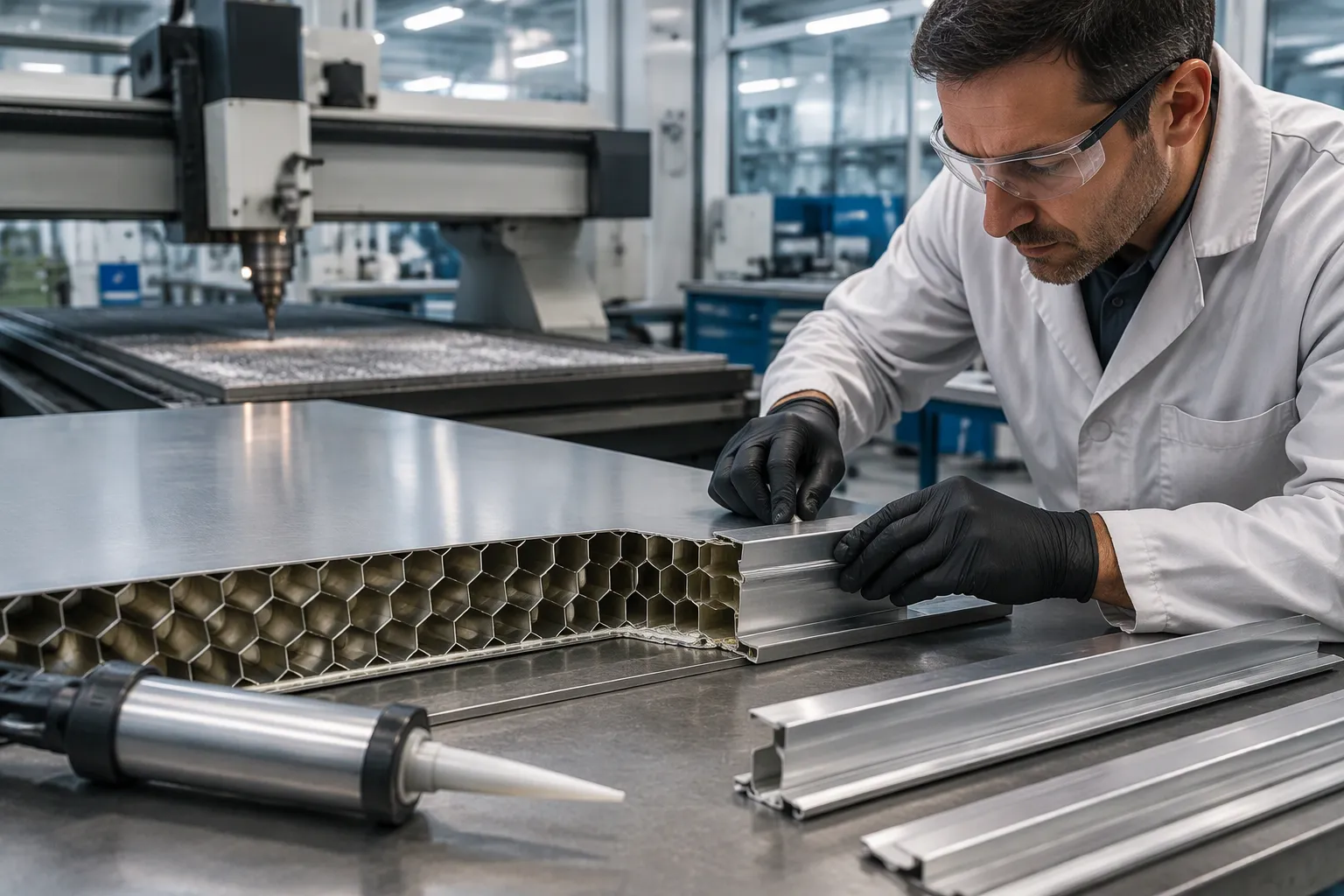
| Reinforcement | Edge reinforcement | Structural resin, aluminum extrusions, or solid composite strips improve impact resistance |
| Fastening | Adhesive bonding | Structural adhesives distribute stress and reduce stress concentration |
| Edge treatment | Edge protection | Aluminum profiles, resin sealing, or composite framing prevent moisture ingress |
Cheonwoo Technology brings years of aluminum honeycomb material manufacturing to these steps. The production chain goes from aluminum foil preparation through adhesive application, core expansion, cutting, surface treatment, and panel assembly. Tight tolerances, multi-axis CNC cutting, and automated fabrication keep cell dimensions, density, bond strength, and flatness steady across large components.
EN 45545-2 Compliance and Cost-Effectiveness
Costs depend on raw aluminum prices, complex fabrication, and energy use.
Fabrication cost reflects bonding complexity, specialized equipment, and skilled labor. Lifecycle cost favors the Honeycomb Panel through corrosion resistance, color retention, and recyclability. Automation in core expansion and panel bonding raises throughput and consistency, which trims unit cost over time.
Summary & Outlook
Aluminum honeycomb panels solve the conflict between fire safety and lightweighting. Buyers should match alloy and cell setup to each use and check EN 45545-2 HL2/HL3 test evidence before approval. Cheonwoo Technology invites procurement teams to ask for specification data, samples, or a technical consultation for their next interior program.
FAQ
Do aluminum honeycomb panels meet EN 45545-2 HL2 and HL3?
Yes. The all-metal build adds no fuel to the fire load. Compliant adhesives complete the system. Testing covers flame spread, heat release, smoke density, and toxic gas emission.
How much weight can a rail interior save?
Panel weight runs 5.5–8.5 kg per square meter, roughly 40–60% lighter than solid aluminum, steel, or GRP parts of similar stiffness.
Which core alloy suits floors versus ceilings?
Floors and structural partitions carry high loads, so 5052 works well there. Ceilings and sidewalls tolerate 3003, the more cost-effective choice.
Post time: Oct-29-2026


