


Modern architects select the metal mirror composite honeycomb panel for ultra-flat, highly reflective surfaces. Traditional glass mirrors present heavy weight, fragility, and optical distortion over large surface areas. Advanced composite technology solves these physical challenges through a rigid aluminum honeycomb core that guarantees extreme flatness across broad spans.
| Metric | 2025 Value |
|---|---|
| Global aluminum honeycomb panels market | USD 3.8 billion |
Industry innovators like cheonwootech manufacture premium metallic mirror aluminum and stainless steel honeycomb panel systems. This lightweight panel optimizes structural durability across every modern interior space. Diverse architectural applications benefit directly from these robust exterior and interior panels installed throughout commercial projects.
Key Takeaways
- Metal mirror honeycomb panels offer smooth, highly reflective surfaces without the heavy weight or fragility of traditional glass mirrors.
- The light aluminum core provides high structural strength while reducing building weight and preventing surface sagging over time.
- Trapped air inside the internal cell structure improves sound dampening, thermal insulation, and overall building fire safety.
- Architects install these versatile, flat composite panels inside elevator cabins, luxury hotel lobbies, transit hubs, and outdoor wall facades.
Features of Metal Mirror Honeycomb Panels
Metallic Mirror Aluminum and Surface Skins
A metal mirror composite honeycomb panel features a sophisticated multi-layer construction. Advanced manufacturing by cheonwootech securely bonds metallic mirror aluminum, titanium, or exterior surface skins to a lightweight interior structural matrix. Modern architectural installations often specify a stainless steel honeycomb panel when extreme surface durability and luxurious aesthetics are required. Cheonwootech utilizes precision lamination processes during fabrication. This expert technique guarantees exceptional reflection quality across every decorative panel without visual optical warping.
Architectural surface sheets undergo specialized finishing processes to achieve outstanding visual clarity. Electropolishing yields a visible light reflectance between 93% and 96% across the 400–700 nm spectrum. Bonding these surface skins to a rigid backing frame requires specialized structural materials.
| Adhesive Material | Tensile / Peel Strength | Temperature / Service Range |
|---|---|---|
| Epoxy structural adhesive | 4,000–6,000 PSI tensile | Rigid gap filling |
| Polyurethane adhesive | 25–40 pli peel strength | 1,500–3,000 PSI shear strength |
| Aerospace-grade film adhesive | Certified sandwich bonding | Service range -65°F to 350°F |
Hexagonal Core Structural Design
The internal architecture relies on an aluminum hexagonal cell configuration. Hexagonal vertex cells provide an even stress distribution similar to circular cell shapes. This structural configuration greatly reduces stress concentrations at the connection points between the core and the outer skin panel. Consequently, these structural honeycomb sandwich panels deliver superior stiffness and high strength while maintaining a lightweight profile. Builders select strong honeycomb panels for demanding commercial installations.
Engineering testing confirms the mechanical durability of this geometric configuration. A 6.35 mm cell size aluminum honeycomb core achieves a plateau stress between 0.906 MPa and 1.192 MPa under compressive testing across varied strain rates. This internal honeycomb core support allows exterior honeycomb panels, ceiling honeycomb panels, and structural honeycomb panels to maintain surface flatness and an overall flatness tolerance of ≤ 2 mm per 2 m across expansive wall systems. Incorporating dense interior support prevents localized surface deflection. Designers select these modern architectural products because their high strength construction guarantees long-term durability, structural integrity, smooth surface flatness, and exceptional high flatness over extended operational lifespans.
Structural Benefits of Honeycomb Panels
Exceptional Strength-to-Weight Ratio
Metal mirror honeycomb panels deliver extraordinary mechanical performance across commercial applications. Solid metal plates often sag under their own weight. In contrast, the internal geometric architecture distributes mechanical loads evenly across the surface. This structural layout provides high strength without adding excessive physical mass. Engineers originally developed these internal geometry principles for critical aerospace components. Today, advanced architectural cladding adopts this same lightweight design to replace heavy solid metal sheets.
The cellular structure features a small solid cross-sectional area. This geometry makes the panel density much lower than ordinary sheet materials. The following image illustrates how panel density compares to solid metal sheets.
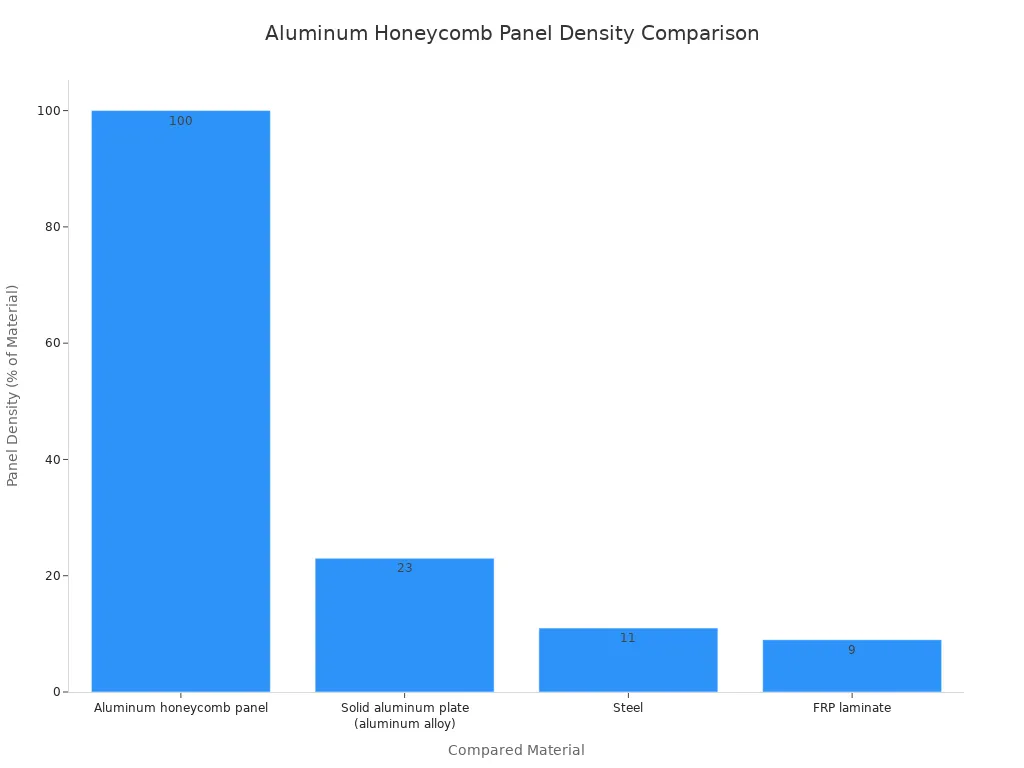
A honeycomb panel has about 23% of the density of a solid aluminum plate. This density difference means the panel is roughly 77% lighter at the same overall volume. Therefore, modern construction projects specify lightweight honeycomb panels to reduce structural dead loads significantly. The overall lightweight profile protects underlying building frames while maintaining superior impact resistance and high strength. Additionally, the outer skins offer exceptional corrosion resistance against atmospheric moisture and environmental exposure. This surface corrosion resistance ensures long service life in harsh environments.
Acoustic and Thermal Insulation
The internal structural core provides notable physical advantages beyond raw strength. Millions of hollow hexagonal cells form the internal core matrix. A dense honeycomb core traps static air inside individual pockets. These trapped air pockets create an effective acoustic barrier that dampens sound vibration between rooms. Consequently, interior spaces stay quieter and feel more comfortable.
The closed cellular core structure also limits thermal energy movement through exterior walls.
- Hexagonal core cells trap air, and since air is a poor thermal conductor, this increases thermal resistance.
- Composite panels reduce continuous conductive pathways through the panel, limiting heat transfer across structural connections and reducing thermal bridging.
One source states that the effective thermal conduction of an aluminum honeycomb panel ranges from 1.03 to 1.07 W/m·K for heat inputs between 2.5 W and 11.8 W. Another explanation notes that the aluminum-foil honeycomb core conducts heat nearly 70 times better than still air, which is why thermal conductivity increases with core wall thickness.
Besides thermal performance, modern honeycomb sandwich panels provide crucial safety benefits for commercial installations. Fire safety remains a primary requirement for public infrastructure and high-rise structures.
| Manufacturer/Product | Certification | Standard | Fire-safety property |
|---|---|---|---|
| Viva FR A1 Honeycomb Panel | FR A1 rating | EN 13501-1 | Non-combustible; zero contribution to fire, smoke, or toxic emissions |
This verified fire resistance classification prevents flame spread during emergency situations. Modern architects select these specialized products for high-traffic public applications. The rigid structural layout prevents surface warping, so the installation preserves optical high flatness over long operational periods. These durable materials maintain pristine surface flatness across large decorative wall systems. Today, leading constructors specify durable composite panels to ensure structural durability across complex aerospace and building projects requiring high strength.
Interior Decorative Applications
Stainless Steel Honeycomb Panel Ceiling Systems
Luxury hotel lobbies, atrium enclosures, and commercial buildings use a metal mirror composite honeycomb panel to transform massive overhead spaces. High surface reflectivity creates visual depth across expansive architectural ceilings. This highly polished surface bounces natural brightness into surrounding dark hallways and deep interior rooms. A stainless steel honeycomb panel provides exceptional high flatness across large ceiling spans without sagging or twisting over time.
Architects select these lightweight ceiling solutions for demanding interior decoration projects in high-end real estate. Standard manufacturing options feature a front sheet thickness of 0.5, 0.7, 0.8, or 1.0 mm bonded over an aluminum core height between 10 mm and 50 mm. A total panel thickness of 15–20 mm is recommended for wall and ceiling applications. Furthermore, these honeycomb sandwich panels achieve an ASTM E84 Class A fire-spread rating to protect interior safety across commercial applications.
Elevator Interiors and Feature Wall Cladding
Shopping mall elevators and feature walls benefit greatly from specialized honeycomb materials and modern surface finishes. Reflective honeycomb panels make compact lift cabins feel visually spacious and welcoming for visitors. Mirror surfaces reflect dynamic light from surrounding displays to improve overall room brightness. Modern interior designs combine 8K mirror finishes with gold or bronze titanium PVD coatings to match commercial branding in retail applications.
| Finish Type | Protective Feature |
|---|---|
| Anti-fingerprint surface finish | Achieves scratch hardness up to 6H and resists oil stains |
| Etched stainless steel | Provides permanent decorative patterns for interior applications |
These durable honeycomb panels retain pristine flatness under severe high-traffic conditions in busy commercial buildings. Specialized protective surface treatments shield each wall panel component from daily wear, fingerprint smudges, and direct contact scratches. Customized ceiling panels elevate visual appeal, while engineered honeycomb panels suit high-end public areas. Consequently, modern interior decoration projects rely on lightweight stainless steel honeycomb panel assemblies to upgrade luxury spaces across diverse building systems.
Exterior Architectural Applications
Exterior Curtain Walls and Facades
Large exterior curtain walls demand strong materials that withstand extreme weather. The metal mirror composite honeycomb panel combines visual beauty with structural resilience. Engineers use lightweight composite construction to reduce overall facade dead load by up to 70% compared to solid aluminum plates. This massive reduction in mass protects structural frames while maintaining excellent high strength against wind loads. Furthermore, advanced surface treatments deliver robust corrosion resistance against atmospheric salt and environmental pollution.
Commercial building facades require reliable long-term performance under direct sunlight and rain. Specifying PVDF fluorocarbon coatings on exterior skins guarantees standard service life exceeding 20 years. These high-performance coatings meet AAMA 2605 specifications and protect reflective metallic surfaces from UV exposure.
Performance Attribute| Exterior Specification Standard |
|
|---|---|
| Outdoor service life | 20 to 30 years |
| Topcoat thickness | 20–30 μm PVDF coating |
| Structural testing | Meets ASTM E330 wind load requirements |
| Impact resistance | Passes Miami-Dade County PA 201-94 missile testing |
Airport Ceilings and Transit Partitions
Modern transit terminals require safe materials for high-traffic environments. High-speed rail interiors and airport ceilings utilize durable honeycomb sandwich panels to maintain structural stability across expansive public spaces. These lightweight assemblies originated in aerospace manufacturing, where structural integrity is critical. A stainless steel honeycomb panel creates smooth overhead surfaces while resisting everyday physical impacts.
The structural core provides high strength to prevent sag across wide spans. This engineered stability ensures permanent surface flatness across large partition walls and ceiling grids. Furthermore, custom fabrication allows edge sealing, precise panel thicknesses, and hidden fixing systems for quick installation.
Multi-scenario application in transit spaces:
1. Terminal canopy cladding and soffits
2. High-speed rail built-in partitions
3. Interior acoustic wall panels
These versatile honeycomb panels suit demanding commercial projects worldwide. Designers select exterior and interior honeycomb solutions to achieve premium mirror finishes across diverse transit applications.
The metal mirror composite honeycomb panel merges luxury aesthetics with high structural strength. This lightweight composite technology replaces heavy traditional glass mirrors across modern building projects. Engineered honeycomb panels deliver distortion-free reflectivity and outstanding impact resistance. Industry leaders like cheonwootech manufacture high-end honeycomb solutions for complex architectural demands. Advanced metallic mirror skins bond seamlessly to a rigid core matrix. Consequently, these structural panels maintain exceptionally flat surfaces across demanding exterior and interior applications. Architects, commercial builders, and designers should specify these innovative materials for future building designs. Contact cheonwootech today to upgrade your next architectural project with high-performance mirror surface solutions now.
FAQ
What are the main applications for metal mirror honeycomb panels?
Architects specify metal mirror honeycomb panels across diverse commercial projects. Primary applications include hotel lobby ceilings, elevator lift cabins, airport terminals, transit partitions, and exterior building curtain walls.
Why select a stainless steel honeycomb panel over solid metal?
A stainless steel honeycomb panel provides high strength with low structural mass. The rigid honeycomb cell layout prevents visual warping, maintaining perfect flatness over large spans. Additionally, this composite assembly offers durable surface performance against daily impact.
How do honeycomb panels enhance interior decoration?
Highly reflective honeycomb panels bounce natural light into rooms to increase visual brightness. The hollow honeycomb core traps static air to damp acoustic transmission. Furthermore, these lightweight decorative panels improve aesthetic quality across any modern interior layout.
Do these building panels provide certified fire resistance?
Yes. Metallic face sheets combined with a honeycomb core deliver outstanding fire resistance. Tested composite assemblies achieve non-combustible ratings under EN 13501-1 standards. These products prevent flame spread while producing zero toxic emissions in emergency situations.
What custom features does a cheonwootech panel offer?
Clients order custom panel skin finishes, edge sealing, and specific overall thickness dimensions. Cheonwootech bonds mirror metal skins to an aluminum honeycomb core. This internal honeycomb matrix reduces shipping weight and simplifies handling during installation. Specialized honeycomb engineering ensures long service life across complex project designs.
Post time: Aug-14-2026


